Most people shopping for a blender are not really shopping for a blender. They are shopping for a morning that works: frozen fruit that turns velvety instead of chewy, ice that disappears instead of rattling around the pitcher, and a machine that is still doing that job six months from now. Then citrus enters the picture and the decision splits in two, because the tool that presses an orange and the tool that pulverizes frozen mango are not the same tool, no matter what the packaging implies. Blenders and citrus juicers fail in different ways, reward different habits, and the fastest way to buy the wrong one is to shop for both jobs at the same time. This guide separates the two jobs, explains what actually determines texture and yield, and then matches four specific machines to the routines they fit.
Related: How to Keep Smoothies From Turning Chewy →
Quick answer
Match the machine to the job you do most days, not the job you imagine doing. If you blend full pitchers for a household or for batch prep, a large pitcher with a strong motor is the shape you want, and you should accept that it will occupy real counter space. If you squeeze citrus most mornings, a dedicated press with adjustable pulp settings handles that single job more cleanly than any blender pitcher can. If you blend one serving at a time, a personal-size set with its own to-go cup is the smaller, simpler answer. Wattage tells you less than pitcher size, blade design, and how easy the machine is to take apart and wash.
Four useful options
| Model | Best fit | What stands out |
|---|---|---|
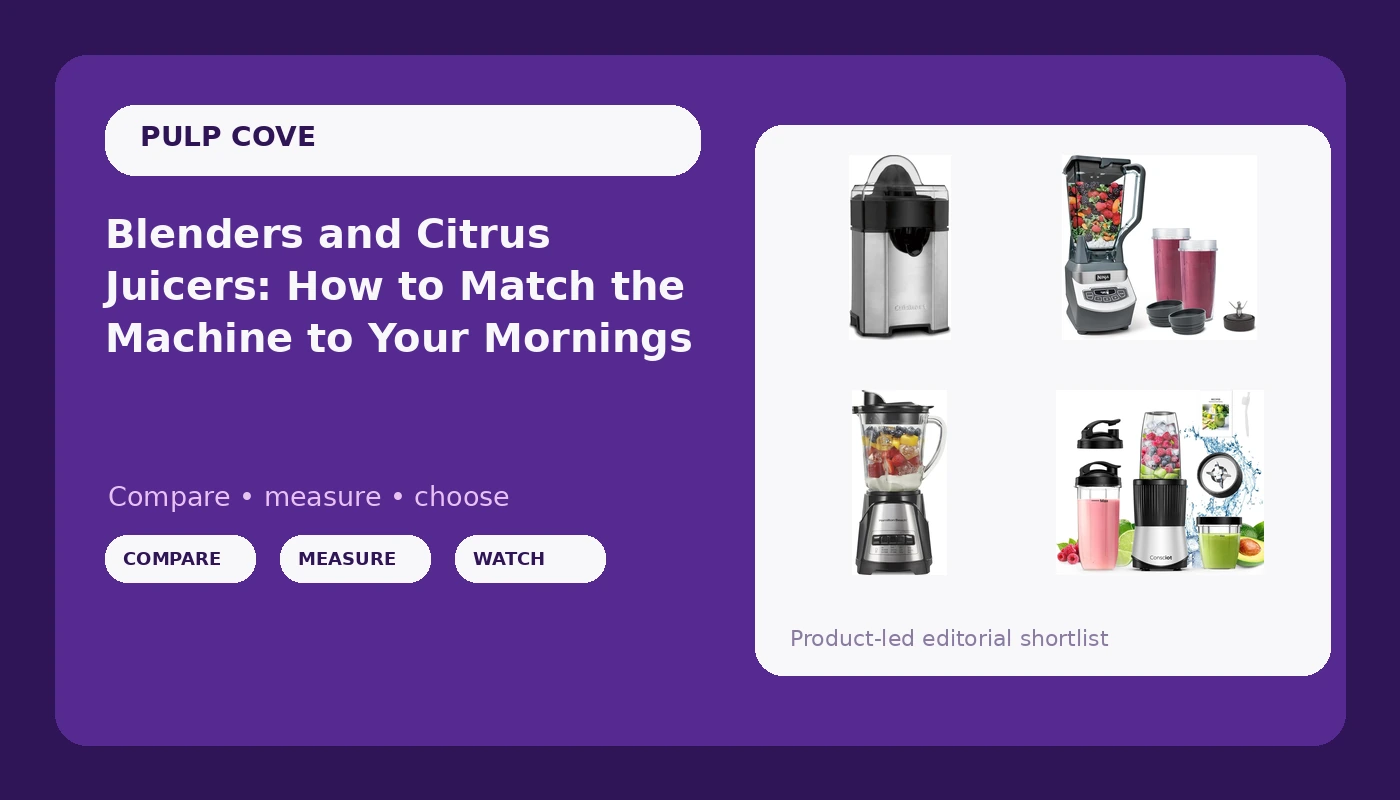
| Ninja BL660 Professional Compact Smoothie & Food Processing Blender, 1100-Watts, 3 Functions -for Frozen Drinks, Smoothies, Sauces, & More, 72-oz.* Pitcher, (2) 16-oz. To-Go Cups & Spout Lids, Gray | Full pitchers, household batches, frozen drinks | 1100 watts, a 72 oz pitcher, and two 16 oz to-go cups with spout lids |
| Cuisinart Pulp Control Citrus Juicer, Orange Juicer Squeezer and Lemon Squeezer with 3 Pulp Control Settings, Accommodates Small Limes and Large Grapefruits, CCJ-500P1, Black/Stainless Steel | Morning citrus, one glass at a time | Three pulp control settings and a size range that runs from small limes to large grapefruits |
| Hamilton Beach Power Elite Blender For Smoothies With Wave Action System | Straightforward smoothie duty on a small budget | A smoothie-focused design built around the Wave Action System |
| Consciot 11-Piece Blender for Kitchen and Personal Size, 900 Peak Watts | Small kitchens, single servings, first blender | An 11-piece set that covers personal-size and kitchen blending at 900 peak watts |
The full-size pitcher: Ninja BL660 Professional Compact Smoothie & Food Processing Blender, 1100-Watts, 3 Functions -for Frozen Drinks, Smoothies, Sauces, & More, 72-oz.* Pitcher, (2) 16-oz. To-Go Cups & Spout Lids, Gray
The trade-off with a 72 oz pitcher is that it is genuinely large. For a single person making one smoothie, that pitcher means more surface to wash and more air whipped into a small batch. It earns its footprint when you are blending for two or more people, prepping several servings at once, or making frozen drinks for a group. Two practical habits matter here. First, do not fill the pitcher past the maximum line and expect the lid to hold, because an overloaded pitcher is how smoothie ends up on the ceiling. Second, use a tamper or stop and scrape rather than stacking frozen fruit above the blades. And keep an eye on texture over time: blades dull on every blender eventually, and the first symptom is usually a smoothie that tastes slightly chewy rather than a machine that stops working.
The citrus specialist: Cuisinart Pulp Control Citrus Juicer, Orange Juicer Squeezer and Lemon Squeezer with 3 Pulp Control Settings, Accommodates Small Limes and Large Grapefruits, CCJ-500P1, Black/Stainless Steel
Citrus is a different mechanical problem from frozen fruit, which is why this machine exists at all. A reamer presses the fruit against a rotating cone and lets the juice drain away from the peel, so you get juice without the bitter compounds that live in the pith and membrane. A blender pitcher does the opposite: it shreds the whole segment, pith included, and the result tastes harsh. The pulp control settings are the feature worth thinking about, because pulp preference is personal and inconsistent. Some people want a clean, strained glass; others want it thick enough to chew. The size range matters just as much, since a machine that cannot grip a lime wastes your money if limes are what you juice. If you only need one glass at breakfast, this occupies less counter space than a full juicing machine and does the job with less cleanup.
The budget smoothie blender: Hamilton Beach Power Elite Blender For Smoothies With Wave Action System
The appeal of a machine like this is that it does one thing and does not ask for cabinet space beyond its own jar. Fewer parts means fewer failure points: no cup-to-base connection to wear out, no separate blade assembly to misplace. The trade-off is ambition. This is not a machine you buy to run four batches back to back on a Sunday, and it does not come with to-go cups, so you will pour into your own. Before buying any budget blender, do three checks on the listing and in your own kitchen. Confirm the jar capacity against how much you actually drink. Confirm which parts are dishwasher safe rather than assuming the whole thing is. And think honestly about noise, because a blender at full power is loud regardless of price, and a thin apartment wall does not care what you paid.
The personal-size set: Consciot 11-Piece Blender for Kitchen and Personal Size, 900 Peak Watts
Two details deserve attention with personal-size sets. The first is the wattage wording: a peak rating describes the highest draw the motor can hit briefly, not what it sustains through a full blend of frozen fruit, so do not read 900 peak watts as the same thing as a large pitcher's continuous rating. The second is the connection point where the cup locks onto the base. That joint takes every vibration the machine produces, and it is the part that tends to loosen or wear over years of daily use. When you unbox a set like this, twist the cup on and off a few times and feel how solid the lock is. If it wobbles now, it will wobble more later. The upside of this category is real: a small cup, a small wash, and a smoothie you can carry out the door.
Prices and availability change. Confirm the current listing, the included parts, and the warranty terms on the retailer page before you buy.
What actually decides smoothie texture
Texture is the whole point, and it is not decided by the number on the box. A blender turns frozen fruit into a smooth drink by cutting it, and cutting requires edges that meet the fruit at speed. As blades dull, they stop slicing and start pushing, so frozen chunks get batted around the pitcher instead of reduced. That is when a smoothie goes from velvety to chewy, and it happens on expensive machines too. Wattage helps a dull blade power through, which is why a strong motor can mask the problem for a while, but power is not sharpness.
Three other variables shape the result. Aeration is the foam on top: some machines whip more air into the drink than others, which is pleasant in a milkshake and unwelcome in a protein shake. Heat is the second: a long run at high speed warms the contents, and a warm smoothie tastes flatter than a cold one. Load is the third, and it is the one you control. Overfilling the pitcher is the most common cause of a lid that pops mid-blend, and tamping ingredients down toward the blades works far better than adding liquid to force them under.
Citrus is a separate job
If you juice citrus daily, treat it as its own purchase rather than a blender feature. Reamer-style presses are fast and cheap to run, and they extract juice while leaving the bitter pith behind. Centrifugal juicers handle volume and speed but are better suited to produce you can feed through a chute. Cold press machines are slower and quieter and tend to extract more from leafy greens, which matters if greens are in your glass. For a single glass of orange juice at breakfast, a simple press wins on counter space and cleanup.
Two buying questions settle most of it. How much juice do you actually drink in a week, and how much of that is citrus? If the answer is a glass a day of orange or grapefruit, a press with adjustable pulp is the efficient choice. If the answer is a quart of green juice every morning, a press will not get you there and you should be shopping in a different category entirely.
- Count the servings you make on a normal day, not your best day, and let that number pick your pitcher size.
- Decide whether citrus is a daily habit or an occasional one, and buy a separate tool only if it is daily.
- Measure the counter space you are willing to give up permanently, including the height under your cabinets.
- Check which parts touch the food, how they come apart, and whether each one is dishwasher safe.
- Plan for the texture curve: assume blades will dull, and pick a machine whose replacement parts and warranty you can actually find later.
Practical guidance before you buy
- Blend a test batch on day one with frozen fruit and ice, and note whether anything survives as a chunk.
- Run the machine at full power and listen honestly. If the noise bothers you in your own kitchen, it will bother a neighbor through a wall.
- Never fill past the maximum line, and keep a tamper or a spatula nearby instead of adding liquid to force ingredients down.
- Wash the parts you use most by hand for the first week so you learn where residue hides before you trust a dishwasher cycle.
- Write down the date you bought it. If smoothies start tasting chewy, you will want to know how many months of use that took.
Which option should you choose?
Choose the Ninja BL660 Professional Compact Smoothie & Food Processing Blender, 1100-Watts, 3 Functions -for Frozen Drinks, Smoothies, Sauces, & More, 72-oz. Pitcher, (2) 16-oz. To-Go Cups & Spout Lids, Gray* when you blend for more than one person, prep batches ahead, or want to-go cups included. Choose the Cuisinart Pulp Control Citrus Juicer, Orange Juicer Squeezer and Lemon Squeezer with 3 Pulp Control Settings, Accommodates Small Limes and Large Grapefruits, CCJ-500P1, Black/Stainless Steel when citrus is a daily ritual and you want control over how much pulp lands in the glass. Choose the Hamilton Beach Power Elite Blender For Smoothies With Wave Action System when you want one simple machine for smoothies and do not need accessories. Choose the Consciot 11-Piece Blender for Kitchen and Personal Size, 900 Peak Watts when you blend single servings, have limited counter space, or want a low-cost set to start with.
None of these are measured claims. Wattage figures, capacities, and part counts come from the manufacturer listings, and real-world noise, durability, and texture depend on what you blend and how often. Read the current listing carefully, check the warranty, and treat the first blend as your own test rather than trusting a description.
The bottom line
Buy for the routine you already have. A large pitcher with a strong motor is the right answer for households and batch prep, and the wrong answer for someone making one shake a day. A dedicated citrus press beats any blender at making orange juice because it solves a different problem, and if you drink citrus daily it deserves its own few inches of counter. A budget smoothie blender and a personal-size set both trade ambition for simplicity, which is a fair trade if simplicity is what your mornings need. Whatever you choose, judge it by the same standard every time: frozen fruit and ice in, something velvety out, no chunks, no chewy bits, and a lid that stays where it belongs.