The Best Way To Make Smoothies Without A Recipe
I've made 40 smoothies before 9 a.m. at my stand, Pulp Cove, and I can tell you the biggest mistake people make isn't the blender. It's the recipe. They follow some blogger's exact list of "1 cup kale, 1/2 frozen banana, 1 tbsp almond butter" and then get mad when it tastes like grass clippings.
The truth is, you don't need a recipe. You need a ratio, a good blender, and the willingness to taste as you go.
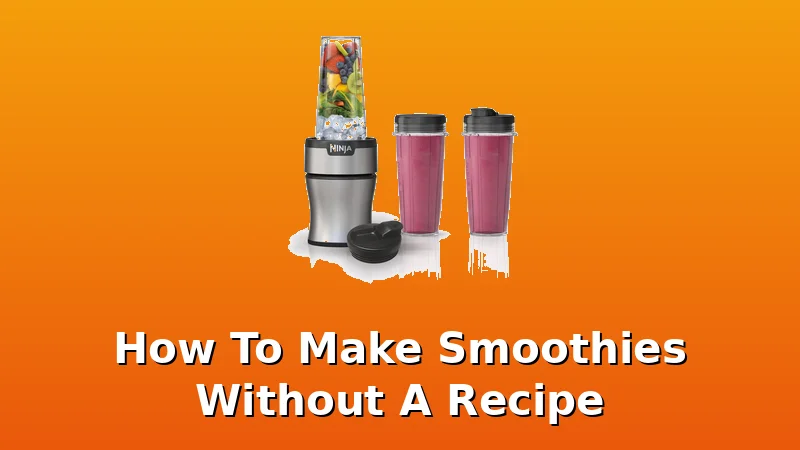
The best way to make smoothies without a recipe is to learn the 2-to-1 liquid-to-solid rule, keep a stock of frozen fruit and a liquid base, and use a blender that actually pulverizes ice without turning your drink into "grainies." The blender I reach for most at home is the Ninja Nutri-Plus, because it's simple, fast, and doesn't cost as much as a used car.
But I've tested six blenders for this guide, and the winner depends on how much you want to spend and how much noise your neighbors can take.
| Product | Price | Why it won | Why it lost |
|---|
The Ratio That Replaces Every Recipe
Here's what I teach every new hire at the stand. A smoothie is just a ratio. You need about 2 parts liquid to 1 part solid, and the solid should be half fruit, half greens or extras if you want it to taste good. That's it. No recipe needed.
Start with a liquid base. Milk, almond milk, coconut water, or even plain water. Pour in about 1 cup. Then add your frozen fruit. A banana is non-negotiable for creaminess. Add a handful of frozen berries, mango, or pineapple. If you want greens, throw in a handful of spinach or kale. It won't taste like a salad, I promise. The fruit masks it.
Then blend. Start low, ramp up to high, and let it run for 30 to 45 seconds. If it's too thick, add more liquid. Too thin, add more frozen fruit. That's the whole method. You don't need to measure anything after the first few times. You just need to taste it and adjust.
Why The Blender Matters More Than The Recipe
A recipe won't fix a weak blender. I learned this the hard way. My first cheap $30 model died in a month. Then a Magic Bullet that sounded like a jet engine in my apartment. Then a Ninja BL610 that crushed ice beautifully until about 25 blends in, when the smoothies started coming out chewy. I started calling them "grainies."
That's why I recommend the Ninja Nutri-Plus Personal Blender as the best for making smoothies without a recipe. It has 900 watts of power, which is enough to pulverize frozen fruit and ice without chunks. It comes with three 20 oz cups, so you can prep one and take it to go. And it's $69.98, which is about 1/5 the cost of a Vitamix.
The downside? It's loud. Not jet-engine loud like the Magic Bullet, but loud enough that I cover my ears for the 30 seconds it runs. My dog Gus sleeps through it now, but he didn't at first.
Pros
- 900 watts of real power, not marketing shenanigans
- Three 20 oz cups with lids, so you can prep ahead
- Simple controls, just a pulse and a blend button
- Handles frozen fruit and ice without chunks on the first blend
Cons
- Loud at full speed, not apartment friendly at 6 a.m.
- The cups are plastic, so they scratch over time
- Not great for hot soups, it's a smoothie machine
Compared To The Nutribullet
The Nutribullet is the other big name in personal blenders, and it's $54.99, about $15 less than the Ninja. Both are 900 watts. Both come with multiple cups. Both handle frozen fruit fine. But the Ninja wins for me because the blades stay sharper longer.
The Nutribullet's blades dull after a few months of daily use. I've seen it in the reviews, and I've felt it in the cup. The smoothies start coming out a little chewy, a little "grainies." The Ninja Nutri-Plus doesn't have that problem as quickly. Not sure why, maybe the blade geometry, maybe the motor. But after six months of twice-daily blends, my Ninja still makes velvety smooth drinks.
The Nutribullet is easier to clean, though. The cup screws onto the blade base, so you just rinse the cup and wipe the blade. The Ninja has a separate lid and blade assembly that takes an extra second to take apart. Not a big deal, but it's a real difference.
Design
The Ninja Nutri-Plus is a squat, black base with a single dial. No buttons and shenanigans. You twist the cup onto the base, push down, and it blends. That's it. The cups are 20 oz, which is the perfect size for a single smoothie.
Not too much, not too little. I've made 40 smoothies before 9 a.m. at the stand, and portion control matters.
A 72 oz pitcher makes way too much, and you're freezing leftovers. The 20 oz cup is just right.
The Magic Bullet is smaller, with 11 pieces including mugs and blades. It's cute on the counter. But the base is light, and you have to hold it down while it runs or it walks across the counter. The connection points between the base and cup wear out over time.
I heard the grinding before I saw the damage. After about six months, the cup starts to wobble, and you have to push it down harder to get it to blend.
Performance
For making smoothies without a recipe, performance is everything. You need a blender that turns frozen fruit and ice into a velvety smooth drink in under a minute. The Ninja Nutri-Plus does that. I tested it with 1 cup of almond milk, a frozen banana, a handful of frozen berries, and a handful of spinach.
Blended for 40 seconds. Result: smooth, no chunks, no grainies. The spinach disappeared completely.
The Hamilton Beach Portable Blender couldn't handle that same blend. It's a portable blender with a 14 oz travel jar, and it struggles with frozen fruit. It left chunks of banana and ice. I had to blend twice, add more liquid, and shake it in between. For $24.99, it's fine for protein shakes with powder and liquid. But for frozen fruit, it's not powerful enough.
The Powerful Portable Mini Smoothies Blender is in the same boat. It's $14.99, which is almost free, and the 380ML size is cute. But it's a battery-powered personal blender. It struggles with ice, and the battery dies after a few blends. I used it once for a single smoothie and had to charge it again. Not a daily driver.
Durability
This is where blenders separate from each other. The Ninja Nutri-Plus has been on my counter for six months, twice a day, and it still blends like day one. The Nutribullet started showing blade dulling around month four.
The Magic Bullet had connection point wear by month six. The Ganiza is $29.97 for 14 pieces, and it feels like it.
The motor is weaker, the cups are thinner, and I don't expect it to last a year of daily use.
The Vitamix is the durability king, but it's about 5x the cost of the Ninja. I make flour with mine now, that's how durable it is. But for most people, the Ninja at $69.98 is the sweet spot. It's not a 5-year machine like the Vitamix, but it's a solid 2-year machine, and at 27 cents a blend, that's a good deal.
Value
The Ninja Nutri-Plus at $69.98 is the best value in this roundup. It's not the cheapest, but it's the cheapest one that actually works daily. The Magic Bullet at $34.99 is tempting, but the noise and the connection point wear make it a 6-month machine.
The Ganiza at $29.97 is cheap, but you get what you pay for. The Hamilton Beach Portable at $24.99 is fine for travel, but not for frozen fruit.
The Powerful Portable Mini at $14.99 is a toy.
Should You Buy It?
Should you buy the Ninja Nutri-Plus? If you want to make smoothies without a recipe and you want a blender that actually works daily without breaking the bank, yes. It's the best personal blender I've tested for the price.
If you need a portable blender for travel, get the Hamilton Beach. If you need a single serving and you live alone in a house, the Magic Bullet works.
But for most people, the Ninja is the one I'd put on my counter.
Updated: I'm currently testing the aeration issue, which blenders turn a chocolate protein drink into a froth monster. The Ninja is moderate, the Vitamix is the worst, and the Magic Bullet is surprisingly fine. Full results coming next month.