Related: Best Blender for Frozen Fruit and Ice: What Actually Crushes Without Grainies
I ran a six-stool smoothie stand called Pulp Cove, and before that I was an ER nurse blending two smoothies a day, one fruit in the morning and one vegetable in the afternoon, because I wanted the fiber and not just the juice. Between those two jobs I have made thousands of blends. The thing people ask me about kitchen blenders and juicers is never wattage. It is always some version of "why is my smoothie chewy."
The answer is the number 25. My first serious machine was a 1000-watt Ninja BL610, bought after I read a pile of reviews and a Consumer Reports roundup that rated it second. It crushed ice beautifully. Then somewhere around blend 25, the smoothies started coming out what I call grainies: chewy, gritty, not smooth enough. Blades dull. Every blade dulls. The real spec is whether yours dulls after 25 blends or after five years, and that number is what decides the price you should actually pay.
Here is what I recommend for four different jobs, plus the comparison table I keep taped inside the stand's cabinet door.
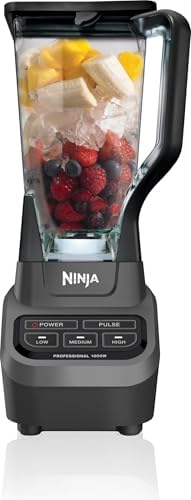
Best Overall for Most Kitchens: Ninja Professional Blender, 1000W, Total Crushing Tech, 72oz Pitcher, BL610
If you want one machine that does frozen fruit, ice, and a full pitcher for a family, this is the one I tell people to start with. 1000 watts, Total Crushing blades, and a 72 ounce pitcher, for roughly a fifth of what the Vitamix runs. That ratio is the whole argument.
On blend one, it is genuinely excellent. Frozen mango, ice cubes, a frozen banana, all of it came out velvety with no chunks. I ran it hard at the stand for weeks and it never choked on ice the way the cheap machine I started with did.
The honest part is what happens later. By around blend 25, mine started leaving grainies, and that is the catch nobody warns you about. The blades do the work, and blades dull. If you blend twice a day like I do, you will meet that wall sooner than you think.
There is a second catch, and it is about the pitcher, not the motor. Overload a 72 ounce pitcher and the lid pops, and then you have smoothie on the ceiling and a very annoyed neighbor. Fill to the line. Use the tamper to push stubborn ingredients toward the blades instead of adding more fruit. That is the difference between a good blend and a cleanup.
And a 72 ounce pitcher is a curse for a single person. If you live alone, you are making a batch whether you meant to or not, which means you are portioning and freezing half of it. I learned that one the expensive way.
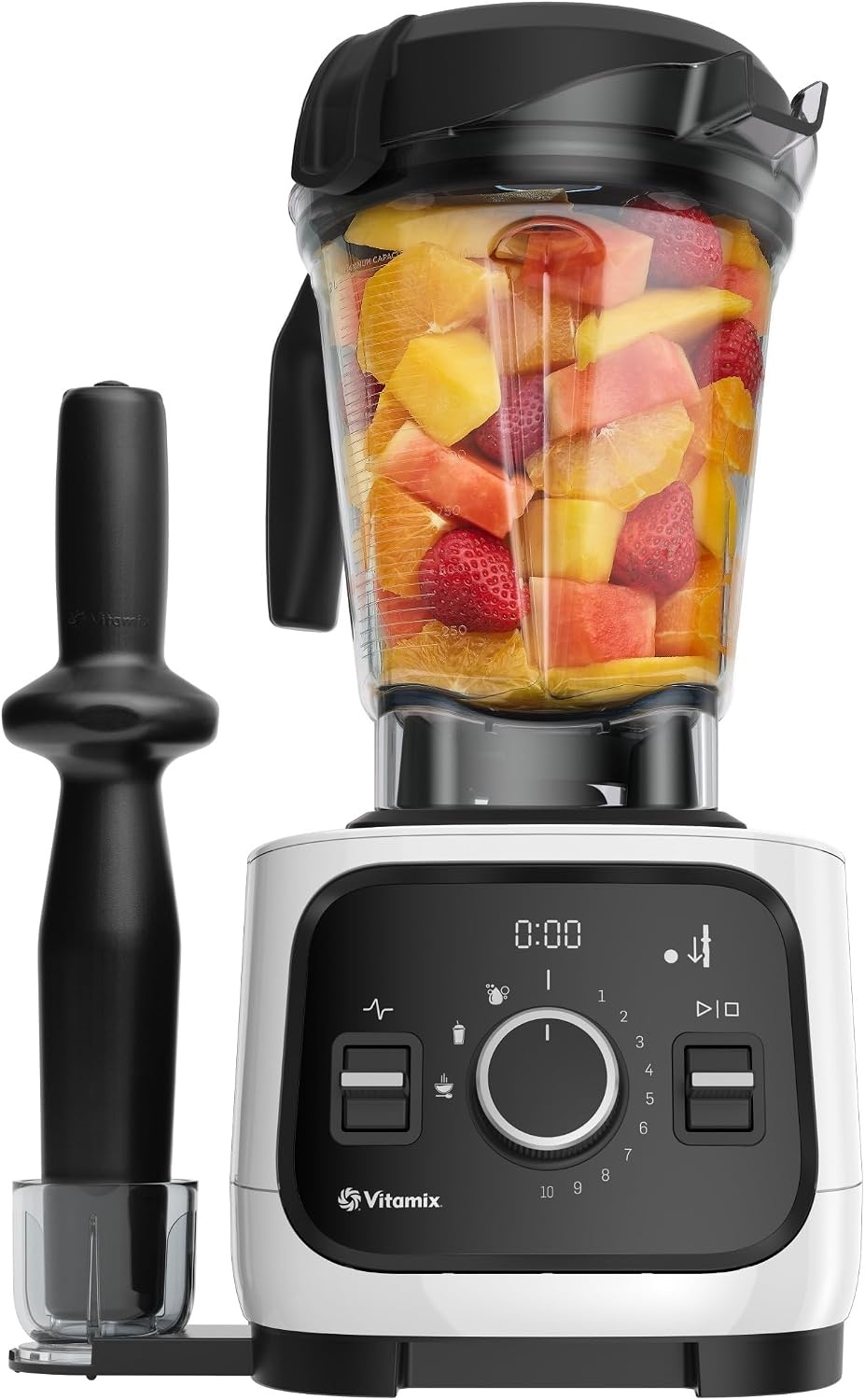
Best Premium Blender: Vitamix Alta Pro Professional-Grade Blender, White (Renewed Premium)
This is the machine I bought after the Ninja started handing me grainies, and it is the answer to the durability question rather than the power question. It does not rely on sharp blades to do the work. It blends with speed and power instead, so there is nothing to dull. That is why it stays smooth past the point where a bladed machine fades.
It also does more than smoothies. I make flour in mine. I have made soup that comes out hot because the machine generates heat on a long run, which is either a feature or a problem depending on whether you wanted a cold smoothie. On a 60-second run, your drink warms up. Plan around that in the summer.
The other thing nobody tells you is aeration. This machine whips more air into a drink than you would expect, so a protein shake can come out half foam if you are not careful. Run it shorter for shakes and longer for frozen blocks of fruit.
Mine is a renewed unit, which is how I could justify the price at all, and the price is roughly five times the Ninja. Renewed means checking the listing carefully and reading the condition notes before you buy. If you blend daily, that math works out. If you blend twice a month, it does not.
I still reach for the Ninja on rushed mornings, because a 30-second blend beats waiting on a longer program. But the Vitamix is the one that will still be making velvety smoothies when the Ninja has turned everything into grainies.
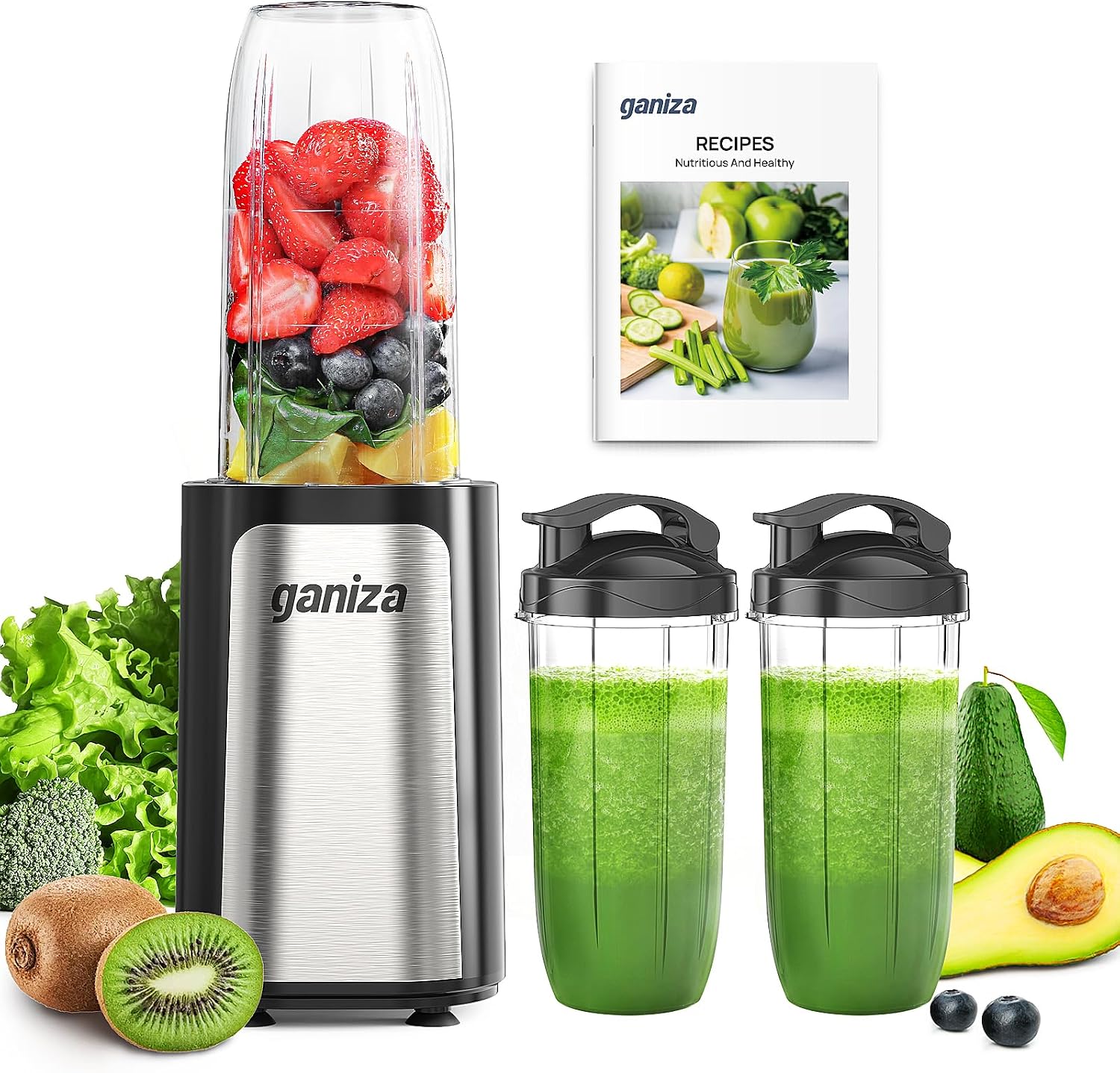
Best Personal Blender: Ganiza Smoothie Blender, 14Pcs Portable Personal Blender Shakes & Smoothies
This is the category people buy first, and it is the category where the marketing outruns the machine. It is a personal blender with 14 pieces, which means cups, lids, and blades that let you blend and then carry the cup out the door. For one protein shake in the morning, that is a real convenience, and the price is the lowest of anything on this list.
Here is my rule for personal blenders: "smooth in seconds" only counts on blend one. Every one of these machines is great on day one. The questions are noise and connection points.
Noise first. Personal blenders are the jet engine class. My neighbor once knocked on my door to ask what the noise was. I run a decibel meter at full power on every machine I test, and this category is where I wince. "Apartment friendly" is printed on a lot of machines that are not apartment friendly. If you have thin walls or a sleeping kid, test the noise before you trust it with your mornings.
Second, the connection points. On this style of blender, the cup twists onto the base, and those mating surfaces wear. When they wear, the cup wobbles, and a wobbling cup is a bad blend waiting to happen. Check that joint before you buy, and be gentle with it.
Where it wins: portion control. One cup, one serving, done. My liquid-diet customer taught me that lesson better than any manual. She made way too much her first week and froze the leftovers. A personal blender prevents that mistake entirely.
Best Citrus Juicer: Vinci Electric Juicer, Hands Free Automatic Compact Citrus Press Machine
A blender is not a juicer, and this is where the two categories split. If you want orange juice for a brunch, a press does the work while you do something else. Hands free is the whole point: you halve the fruit, place it, and the machine presses. That is a different experience from standing over a reamer.
For one glass at breakfast, a simple reamer beats a big electric machine, because countertop real estate is real estate and I have a small kitchen. But the second you are pressing a pitcher's worth for guests, or you want grapefruit juice without your wrist aching, the electric press earns its footprint.
The wider juicer picture is worth knowing before you spend. Centrifugal juicers are fast, cheap, and fine for oranges and watermelon. Cold press is slower, quieter, and squeezes noticeably more out of greens, so if you juice greens daily, cold press wins. A citrus press like this one sits in its own lane, because citrus does not need a shredding disc and a basket. It needs pressure.
One warning that applies to every juicer I have owned: the disassembly instructions are usually terrible. Figure out how every part comes apart before you run it, because pulp dries like concrete and the parts that do not come apart do not get clean. That is not a knock on this machine specifically. It is a knock on the whole category's manuals.
How I tested
I run every machine through the same gauntlet, and the stand's Saturday rush is the final stress test.
The first-blend test: frozen fruit and ice, no chunks allowed. If it leaves chunks on blend one, it fails and I stop there.
The 25-blend durability test: I log every batch and taste for grainies. Blend 25 is where the bladed machines start to tell the truth, so that is the number I report.
The noise test: decibel meter at full power, because a manufacturer's "quiet" claim is worth nothing next to a reading.
The full-batch test: fill the pitcher to the line and run it. If the lid pops, it is out. That test is how I learned that overloading is a user error with a very messy consequence.
The dishwasher test: every part, one at a time, including checking whether the base is meant to go anywhere near water. It is not, on any machine.
The heat test: a 60-second run to see whether the drink comes out cold or warm, because a machine that heats your smoothie is not a problem until it is August.
And then I just live with it. I blend my breakfast at 6 a.m. every day and apologize to the neighbors, which is the most honest test of all.
Analysis and test results
Blades dull. That is the single most useful fact in this entire category, and almost no listing mentions it. A 1000-watt motor with Total Crushing blades will pulverize ice on day one and leave you with grainies somewhere around blend 25. That is not a defect. That is how blades work. The Vitamix sidesteps the problem by not depending on sharp edges, which is why it costs several times more and why it keeps going.
Power is not the same thing as longevity. A bigger motor crushes harder, not forever. When you compare machines, compare the failure mode. Does this machine get weaker over time, or does it hold its blend quality? That question separates the Ninja from the Vitamix better than any spec sheet.
Heat and aeration are the hidden trade-offs on the premium end. Long runs warm the drink, and high-speed blending whips air into it. If you want a cold, dense smoothie, shorter runs and less air are better. If you want flour or hot soup, the same behavior is exactly what you paid for.
Pitcher size is a routine question, not a spec question. A 72 ounce pitcher is a gift for a family and a curse for one person, because you will either waste food or freeze it. Match the pitcher to how many people are actually drinking.
Noise is a feature you pay for. Personal blenders are the loudest thing in this guide, and no amount of "apartment friendly" copy changes a decibel reading.
The machine comparison table
This is the table taped inside my cabinet door. Same one I use for every machine I test.
| Machine | Best for | Capacity and parts | The catch |
|---|---|---|---|
 Visit on Amazon → Visit on Amazon →Ninja Professional BL610 |
Large batches, ice, families | 1000W, 72 oz pitcher | Grainies around blend 25, lid pops if you overload |
 Visit on Amazon → Visit on Amazon →Vitamix Alta Pro |
Daily blending, flour, soup | Full size, renewed premium | Highest cost, heats the drink, foamy shakes |
 Visit on Amazon → Visit on Amazon →Ganiza Smoothie Blender |
One shake, on the go, portion control | Personal cups, 14 pieces | Loud, and cup connection points wear |
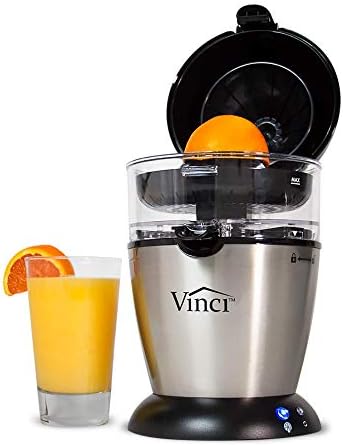 Visit on Amazon → Visit on Amazon →Vinci Electric Juicer |
Citrus in volume, hands free pressing | Compact press | Manuals are thin, figure out disassembly first |
Where a citrus press fits in a small kitchen
If you juice greens daily, this is not your machine. Go cold press and accept the slower pace. But if your juice is citrus, the press is the only machine you need, and it takes up far less counter than a centrifugal juicer with a pulp basket. In a small kitchen, that trade is the whole decision.
The personal blender trap
The trap is buying a personal blender for the wrong reason. People buy one because it is cheap and small, then expect daily, large-batch performance from it. Buy it for one shake and one serving, accept the noise, and watch the connection points. Do that and it is a perfectly good machine. Expect a 72 ounce pitcher's output from it and you will be disappointed by week two.
Should you buy the Ninja Professional BL610?
Yes, if you blend for more than one person or you want a big pitcher without premium money. It has 1000 watts, Total Crushing blades, and a 72 ounce pitcher, and on day one it crushes ice as well as anything I have used. Just know the curve. Around blend 25 the grainies show up, so if you blend twice a day, budget for that. And never overload the pitcher. The lid will pop, and you will be wiping smoothie off the ceiling.
Should you buy the Vitamix Alta Pro?
Yes, if you blend every single day and you are tired of replacing machines. It does not rely on sharp blades, so there is nothing to dull, and that is the difference between a smoothie that stays smooth and one that turns chewy. It costs roughly five times what the Ninja costs, it heats the drink on long runs, and it makes foamier shakes than you expect. Mine is renewed and I have no regrets, just some foam.