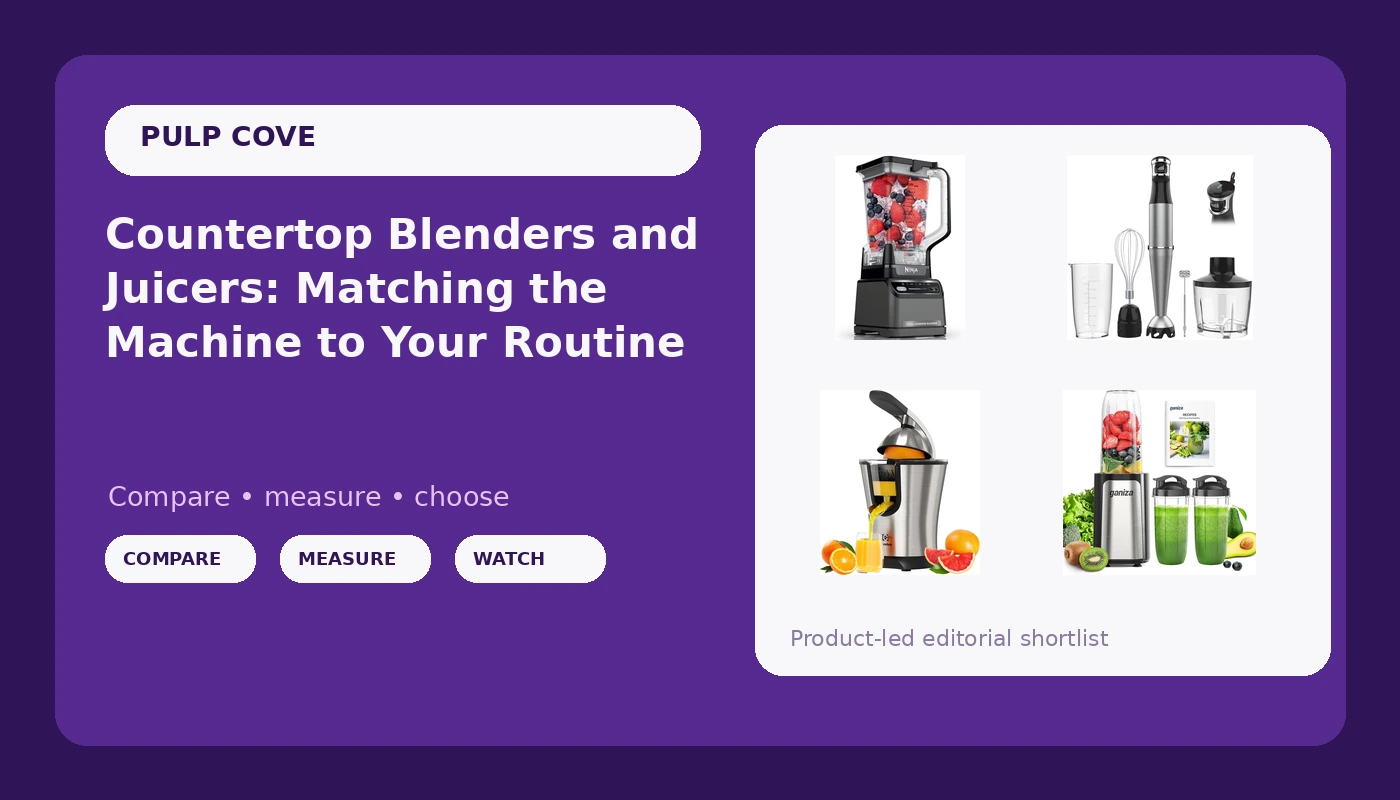
Most people shopping for countertop blenders and juicers start with the same question and end up with the wrong machine. The question is usually which one is best, and the honest answer is that the format matters more than the badge on the front. A 72 oz pitcher is a workhorse for a household that batch-blends once and drinks all week, and a nuisance for one person making a single shake before work. A handheld immersion blender that lives in a drawer handles soup, sauce, and small jobs in the pot you already dirtied. An electric citrus squeezer does one thing extremely well. A personal blender with a cup that doubles as the travel vessel handles exactly one serving at a time.
None of those formats replaces the others. Wattage and pitcher size, the numbers that get printed in bold on a box, tell you less than you would expect about whether a machine earns its counter space. What follows is a breakdown of four options, what each format is built to do, and how to work out which one belongs in your kitchen.
Related: Cleaning Blenders and Juicers Without Ruining the Blades →
Quick answer
Match the machine to your batch size before you compare anything else. A full-size pitcher blender is the right call for frozen fruit, ice, and multi-serving batches. A handheld immersion blender is the right call for partial batches, soups, and sauces you blend in the vessel you are already using. A personal blender is the right call for a single shake and a small footprint. An electric citrus juicer is the right call when fresh orange or grapefruit juice is a regular habit. No single model here is the best at everything, and nothing is worth buying for a job you do twice a year.
Four useful options
| Model | Best fit | What stands out |
|---|---|---|
| Ninja Professional Blender 2.0, 1200W, Auto-iQ, 72oz Pitcher | Large batches, ice, and frozen fruit | 1200-watt motor, Auto-iQ programs, 72 oz pitcher |
| Turelar Immersion Blender Handheld Corded, 1100W 5 in 1 Hand Blender Set | Small batches, soups, sauces, blending in the pot | Corded handheld design, 1100 watts, 5-in-1 set |
| Eurolux Premium Electric Orange Juicer | Citrus juice at breakfast, glass by glass | Stainless steel citrus squeezer body, auto shutoff, pulp control |
| Ganiza Smoothie Blender, 14Pcs Portable Personal Blender Shakes & Smoothies | One serving at a time | Personal blender format, 14-piece set |
The full-size pitcher blender: Ninja Professional Blender 2.0
The case for this machine is capacity and ice. A 1200-watt motor paired with a 72 oz pitcher is aimed at the job most people actually buy a blender to do: frozen fruit and ice in volume, not one banana. The Auto-iQ programs take some of the guesswork out of run times, which matters when you are blending before you are fully awake. The trade-offs are footprint and batch discipline. A pitcher this size is the largest object in this group, so it needs counter or cabinet space you may not have, and it rewards restraint: fill past the maximum line and you are testing the lid rather than the blades. If you blend for one, the pitcher is more machine than the job requires, and the leftover volume becomes a portion-control problem rather than a feature.
The handheld option: Turelar Immersion Blender Handheld Corded, 1100W 5 in 1 Hand Blender Set
Immersion blenders solve a different problem. Instead of moving ingredients into a pitcher, you put the shaft into whatever already holds them: a stock pot, a quart container, a measuring cup. That makes this set a natural fit for soup, tomato sauce, and small batches that would be lost at the bottom of a 72 oz jar. A corded handheld at 1100 watts has a different job description than a pitcher blender. It is not the tool for a tray of ice cubes, and the blade sits at the end of a shaft you have to keep submerged and angled correctly to avoid splatter. The 5-in-1 configuration broadens the jobs it can take on, and the whole thing stores in a drawer. If you blend in the pot, this is the format that makes sense.
The citrus specialist: Eurolux Premium Electric Orange Juicer
A dedicated citrus machine is a narrow purchase, and that narrowness is the point. The Eurolux is built around a stainless steel citrus squeezer body with a soft grip handle, an auto shutoff function, and pulp control, which is the setting that decides whether you pour a glass you like or a glass you have to strain. Dishwasher-safe parts matter more here than on a blender, because citrus is sticky and a daily habit means daily cleaning. The trade-off is scope. An electric orange juicer presses citrus and essentially nothing else, so it earns its space only if citrus juice is a routine rather than an occasional project. If you want one glass at breakfast, a manual reamer does the job with no cord. If you are pressing a bag of oranges at a time, the electric machine is the difference between a habit and a chore.
The personal blender: Ganiza Smoothie Blender, 14Pcs Portable Personal Blender Shakes & Smoothies
Personal blenders are the smallest commitment and the most limited. The Ganiza is a cup-based design meant for shakes and smoothies, and the 14-piece set suggests a package built around that single-serving routine, with cups and lids that travel. The trade-offs are scale and the wear on the connection points. A cup that attaches to a base is convenient right up until the interface loosens, and a personal blender is not the tool for a full pitcher of frozen fruit or for anything that needs a tamper. If your morning is one shake and your kitchen is small, this is the format that fits. If you blend for two or more, you will spend more time running batches than the smaller footprint saved you.
Prices and availability may change. Product images, names, and retailer links are matched to verified listings. No current price, rating, stock status, or measured result is stated here without current evidence.
What each format is actually built to do
The four machines here share a name and very little else. A full-size pitcher blender sets a jar on a motor base with blades at the bottom of the jar, which is why it handles volume and ice but also why it needs a tamper, a maximum fill line, and a lid you should not overload. Blades dull with use, and a dull blade is what turns a smooth blend into something chewy, so blade condition is a real cost of ownership rather than a footnote. An immersion blender puts the blade at the end of a shaft, which means it works in any vessel deep enough to submerge the head, but the blade is small and the machine is not built for frozen blocks. A personal blender attaches a single-serve cup to the base, which makes cleanup easy and capacity fixed, and it puts the wear on the cup threads and gaskets. An electric citrus juicer spins a reamer under half a piece of fruit, which is why pulp control and auto shutoff exist on that class of machine and not on blenders.
Wattage is worth understanding before you shop on it. It describes motor input, not texture. Pitcher geometry, blade design, fill level, and how you load the jar all influence whether frozen fruit comes out smooth, which is why a higher number on a box does not automatically mean a better result in a glass.
How to match a machine to your routine
- Count the servings in your typical blend. One, two, or four? Batch size decides format more than any spec sheet does.
- List what actually goes in. Ice and frozen fruit favor a pitcher blender, soup and sauce favor an immersion wand, and citrus favors a juicer.
- Measure the space you have. Counter and cabinet inches are the constraint nobody accounts for, and a 72 oz pitcher needs somewhere to live.
- Decide your cleanup tolerance. Blade assemblies, gaskets, and pulp screens all need attention, and a machine you avoid cleaning is a machine you stop using.
- Check how it comes apart and which parts are dishwasher-safe. Confirm that on the listing rather than assuming the whole machine can go in.
Keeping blades, seals, and pitchers in working order
- Load liquid first, then soft ingredients, then frozen fruit and ice last, so the blades have something to pull down into the mix.
- Respect the maximum fill line. Overloading a pitcher is what pops lids, and a popped lid is a cleanup, not a warranty claim.
- Use a tamper or stop and stir rather than packing ingredients toward the blades by hand.
- Rinse and dry blade assemblies and gaskets promptly, since residue that dries on a seal is where leaks start.
- Check the cup connection points and gaskets on a personal blender periodically, because that interface is the part that wears first.
Which option should you choose?
Choose the Ninja Professional Blender 2.0 when you blend for more than one person, work with ice and frozen fruit in volume, and have the space for a 72 oz pitcher. Choose the Turelar Immersion Blender Handheld Corded, 1100W 5 in 1 Hand Blender Set when your blending happens in a pot or a container you already own and you want something that stores in a drawer. Choose the Eurolux Premium Electric Orange Juicer when fresh citrus juice is a regular habit and you want pulp control plus dishwasher-safe parts. Choose the Ganiza Smoothie Blender, 14Pcs Portable Personal Blender Shakes & Smoothies when your routine is one shake at a time and counter space is the deciding constraint.
Those four use cases overlap at the edges, and the honest tiebreaker is not a specification. It is how many servings you make most days, how much room you can give up, and how much cleaning you will tolerate before the machine stops getting used. Nothing here reports a measured result, a rating, or a current price, so verify current specifications, included parts, and availability on the listing before you buy.
The bottom line
The right machine is the one whose format matches the batch you make most often. If that is a full pitcher of frozen fruit and ice for the week, a full-size pitcher blender is the fit and everything else will feel like a compromise. If it is soup on a weeknight, an immersion blender in the pot is the fit and a pitcher is just another thing to wash. If it is a glass of orange juice every morning, a citrus juicer earns its space and a blender does not. If it is one shake before work, a personal blender does the job and a 72 oz jar does not. Buy the format first, then compare models inside it, and treat blade condition, connection points, and cleanability as the costs that decide how long the machine stays useful.