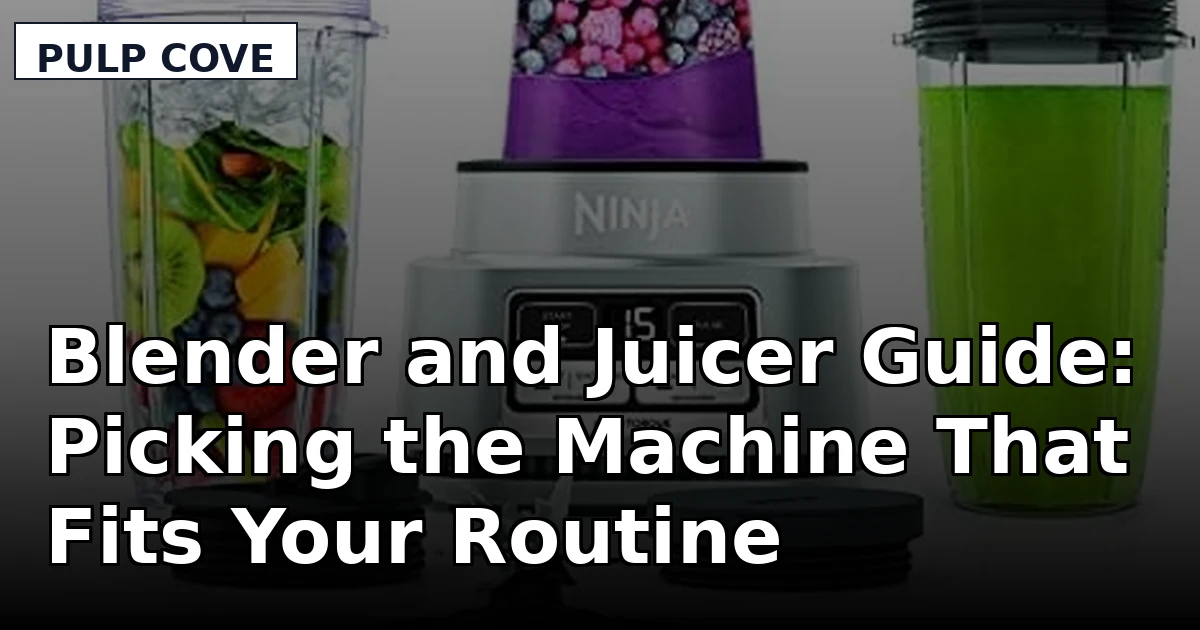
A blender and juicer guide usually opens with wattage, and wattage is the least useful number on the box. What decides whether a machine keeps its spot on your counter is simpler than a spec sheet: how much you blend at once, what you put in it, and how much cleaning you will tolerate on a weekday morning. Frozen fruit and ice ask one thing of a motor. Leafy greens and fibrous vegetables ask something else. A 16 oz cup and a 72 oz pitcher are not the same purchase wearing different labels.
That is where the shelf gets confusing. Personal blenders, full-size pitchers, combo units, and juicers all promise a smooth result in seconds, and that promise is only ever tested on blend one. Blades dull. Connection points between a base and a cup wear. A lid that pops under a full batch does not care how many stars a listing carries. The four machines below are sorted by the job each one actually does, so you can match the machine to your routine instead of the other way around.
Related: How to Keep Smoothies From Turning Grainy →
Quick answer
Match the machine to your volume and your texture. A personal blender with a 1200-watt motor and a smoothie bowl maker covers single servings and thicker, spoonable blends. A full-size machine with a 72 oz pitcher and programmed cycles covers batch blending for a household or a week of prep. A 600-watt combo with both a pitcher and a to-go cup covers small kitchens that want one base for two jobs. A cold press juicer covers daily vegetable and green juice, where slow extraction is the point rather than speed.
Four useful options
| Model | Best fit | What stands out |
|---|---|---|
| Ninja Foodi Personal Blender & Smoothie Bowl Maker, 1200PW, SS101 | Single servings and thicker blends | 1200-watt motor plus a dedicated smoothie bowl maker |
| Ninja Professional Blender 2.0, 1200W, Auto-iQ, 72oz Pitcher, BR201AMZ | Batch blending for two or more | 1200 watts, Auto-iQ programs, 72 oz pitcher |
| magic bullet Combo Blender, 600W, 48oz Pitcher, 16oz Cup with To-Go Lid | Small kitchens that want one base for two jobs | 600 watts, 48 oz pitcher, 16 oz cup with to-go lid, cross blade |
| Cold Press Juicer Machines | Daily green and vegetable juice | Slow cold press extraction instead of high-speed spinning |
The single-serve pick: Ninja Foodi Personal Blender & Smoothie Bowl Maker, 1200PW, SS101
A personal blender solves a volume problem, not a power problem. If you make one shake before work and one green smoothie in the afternoon, a full pitcher is a liability: you either underfill it and get a poor blend, or you fill it and drink more than you wanted. The catch with the personal format is everything above the base. Cups and blades wear at the connection points, so a cup that spins true in month one can wobble by month six. Noise is a genuine feature of the category too. Compact machines run a small jar at high speed, and through an apartment wall that reads as a jet engine. Test both before you trust one with your mornings: run it at full power, and check how the cup seats on the base.
The batch pick: Ninja Professional Blender 2.0, 1200W, Auto-iQ, 72oz Pitcher, BR201AMZ
A 72 oz pitcher is a tool for a specific kitchen. It shines on Sunday prep, when you blitz a full batch of frozen fruit and portion it out for the week, and it is genuinely awkward for one person making one drink. Two things decide whether a big pitcher works for you. First, whether the lid holds through a full load. Overloading is the most common way a smoothie ends up on the ceiling, and the fix is a tamper or a smaller batch, not a tighter grip. Second, whether the blades stay sharp. Every blade dulls eventually, and the number that matters is whether that happens after 25 blends or after five years, because that is when smoothies turn chewy and grainy. Wattage tells you nothing about that timeline.
The budget combo pick: magic bullet Combo Blender, 600W, 48oz Pitcher, 16oz Cup with To-Go Lid
The combo format exists because countertop real estate is real estate. One base, a 48 oz pitcher for sauces and larger batches, and a 16 oz cup with a to-go lid for the morning shake is a lot of utility in a small footprint. Hot blends deserve a caution: heat builds pressure inside a sealed jar, so venting and not overfilling matter more than the recipe does. Cleaning is the quiet advantage here. A blender you can rinse in under a minute gets used; one that needs a full disassembly every single time does not. Check that the cup and blade assembly come apart without a fight before you commit, because that is the part you will handle twice a day.
The juicing pick: Cold Press Juicer Machines
Juicing is a different job with a different output. A blender keeps the fiber in the glass; a juicer separates it out. Cold press machines crush and press produce slowly instead of shredding it against a fast spinning basket, which is why they handle leafy greens and fibrous vegetables that a centrifugal juicer tends to leave behind. The trade is time and parts: slower feeding, and more components to wash afterward. If you want one glass of orange juice at breakfast and nothing else, a simple reamer on the counter beats a full machine. If greens are the point and you juice most days, the slow method earns its space.
Prices and availability may change. Product images, names, and retailer links must be matched by verified ASIN. Do not state a current price, rating, stock status, or measured result without current evidence.
What wattage actually tells you
Wattage is a rating of motor power, and it is the easiest number to print and the hardest one to shop by. Two machines rated at 1200 watts can produce very different textures, because the result also depends on blade geometry, jar shape, and how the machine manages speed under load. A narrow personal jar with a cross blade creates a different flow pattern than a wide 72 oz pitcher, and flow is what pulls ingredients down into the blades instead of letting them spin around the walls.
Three things matter more than the number on the box.
Texture under load. Frozen fruit and ice are the real test. A machine that handles a fresh banana easily can stall on frozen mango, and stalling is what leaves chunks behind.
Aeration. Fast spinning whips air into a drink. Some foam on top is normal, and a protein shake that comes out half air is the practical consequence. If you drink shakes for the protein, foam is a real cost.
Heat. A long run warms the contents. That is how a high-performance machine can turn a cold smoothie lukewarm, and it is also how hot blends become possible in the first place.
Durability sits outside all three. Every blade dulls, and the honest question is when.
Cold press juicing versus blending
These two categories get compared because both take whole produce and give you a drink. The difference is what ends up in the glass. A blender keeps the fiber, which is why a daily green smoothie works as a fiber delivery system rather than a juice. A juicer removes the pulp, which is why a glass of juice is lighter and why yield per pound of produce becomes the number that matters over time.
Cold press machines use a slow crushing and pressing action. Centrifugal juicers shred produce against a fast spinning basket and separate the juice with force. Cold press is slower to feed and generally involves more parts to clean, and it handles greens and fibrous vegetables more completely. Centrifugal machines are faster and less expensive, and they are fine for oranges, apples, and watermelon. Neither one replaces the other. If your goal is fiber, blend. If your goal is a concentrated green juice, press.
- Decide the volume first: one serving, two servings, or a week of batches.
- Decide the texture you want: a drinkable smoothie, a spoonable bowl, or juice with the pulp removed.
- Look at what comes in the box, whether that is a pitcher, a cup with a to-go lid, a bowl maker, or a juicing assembly.
- Check the cleaning path before buying. Every part that touches produce has to be washed.
- Run the first blend with frozen fruit and ice, and watch for chunks.
Practical guidance for small kitchens
- Measure your counter space before you fall for capacity. A machine that does not fit gets stored, and a stored blender is a retired blender.
- Buy for your weekday routine, not your best-case Sunday.
- Batch, then portion. Freeze single servings so a full pitcher does not turn into a full pitcher of leftovers.
- Wash the blade assembly and the cup connection points by hand when the manual is unclear. Worn connection points are what make a cup wobble on the base.
- Time your loudest blends around your neighbors, or accept that a 6 a.m. smoothie is a shared experience.
Which option should you choose?
Choose the Ninja Foodi Personal Blender & Smoothie Bowl Maker, 1200PW, SS101 when you blend one or two servings at a time and want thicker, spoonable textures alongside drinks. Choose the Ninja Professional Blender 2.0, 1200W, Auto-iQ, 72oz Pitcher, BR201AMZ when you blend for more than one person or prep a week of smoothies at once. Choose the magic bullet Combo Blender, 600W, 48oz Pitcher, 16oz Cup with To-Go Lid when counter space is tight and you want one base that covers both a pitcher job and a travel cup. Choose the Cold Press Juicer Machines when green and vegetable juice is the daily habit and you are willing to trade speed and cleanup time for extraction.
Two caveats. Volume is the first decision, not the last one, so a machine that is too big for your routine will sit unused no matter how capable it is. And durability is not something a listing can tell you. Blade sharpness, connection wear, and lid behavior show up only after repeated use, which is why a first-blend test and a look at how the parts disassemble are worth more than any single specification.
The bottom line
No single machine covers every job here, and that is the honest answer. Personal blenders win on volume control and cleanup. Full-size pitchers win on batch prep. Combos win on footprint. Cold press juicers win on greens. Decide which of those four jobs you actually do most mornings, buy for that one, and treat the rest as optional. Then test the machine the way it will be used: frozen fruit, ice, a full container, and a stopwatch on the noise. If the first blend comes out velvety and the parts come apart for washing without a fight, you bought the right one. If it comes out chewy, you have met the grainies, and the countdown to a new blade or a new machine has already started.