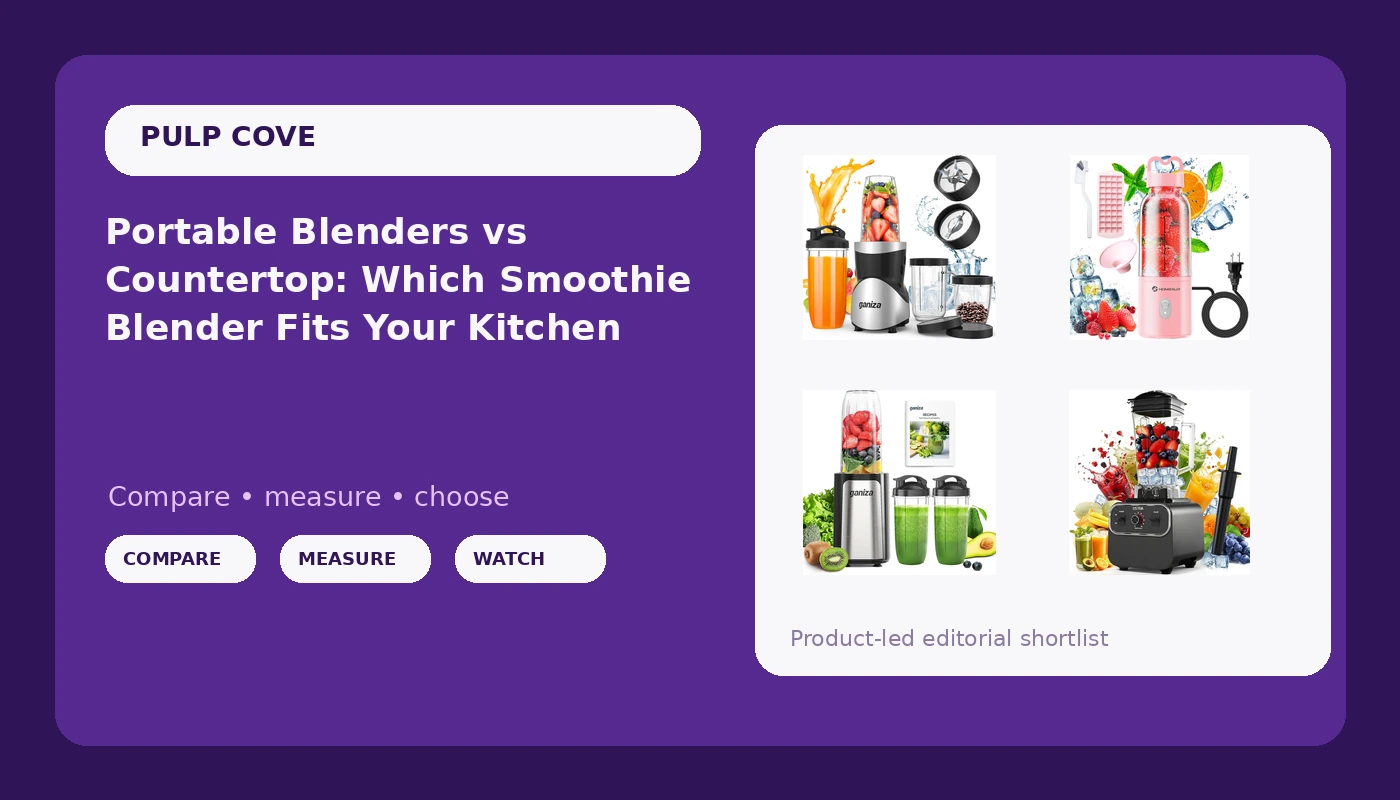
If you have ever stood in an aisle weighing a 17-ounce travel cup against a 68-ounce pitcher, you already know the real question behind shopping for personal blenders for smoothies. It is not which machine is strongest. It is which machine matches the way you actually eat breakfast. One person blending a single shake before work and a household blitzing a full pitcher on Sunday morning need opposite things from the same category, and the spec sheet rarely says so out loud. Wattage, capacity, and how many pieces come in the box tell you far more than the badge on the front. What follows is a plain comparison of four options and a way to decide between them without paying for capability you will never use.
Related: Why Blades Dull and Smoothies Turn to Grainies →
Quick answer
Match capacity to your batch size first, then match wattage to what you actually put in the cup. A 68-ounce, 1600-watt countertop machine is built for full pitchers, ice, and frozen fruit. A 17-ounce personal blender with a 175-watt motor is built for one serving of soft fruit, yogurt, and liquid. If you blend one serving a day for one person, a personal blender is the practical pick. If you blend for several people, crush ice regularly, or batch prep for the week, a countertop model with a larger pitcher is the practical pick.
4 useful options
| Model | Best fit | What stands out |
|---|---|---|
| OSTBA 1600W Commercial Professional Blender for Kitchen | Full pitchers, ice, and frozen fruit in volume | 68 oz BPA-free pitcher, 1600W motor, 10-speed control, 6-leaf blade assembly |
| Ganiza Smoothie Blender, 900W Blenders Shakes and Smoothies | Everyday countertop blending for one or two people | 900W motor in a single countertop unit |
| Ganiza Smoothie Blender, 14Pcs Portable Personal Blender Shakes & Smoothies | Grab-and-go single servings with accessories | 14-piece set built around a personal blender format |
| HOMEXUP Portable Personal Blender 17oz, 175W Smoothie Maker, Pink | Light single-serving jobs in a small space | 175W motor, 17 oz cup, compact pink body |
The big-batch machine: OSTBA 1600W Commercial Professional Blender for Kitchen
This is the only machine in the group built around a pitcher rather than a cup, and that changes the whole routine. A 68-ounce pitcher means one blend covers several servings, which is what batch prep looks like in practice: one mess, one rinse, four drinks in the fridge. The 10-speed dial is the part people underestimate, because it lets you start slow on frozen blocks and ramp up instead of slamming everything at full power from a standstill. The trade-off is real estate. A full-size pitcher takes countertop inches permanently, it is more surface to wash, and if you live alone you will sometimes blend a single smoothie in a machine designed for six. Buy it for volume, not for one cup.
The everyday countertop blender: Ganiza Smoothie Blender, 900W Blenders Shakes and Smoothies
If you blend once or twice a day and you want a machine that lives on the counter, this is the middle of the road, and the middle of the road is where most kitchens actually sit. Nine hundred watts is enough headroom to work through frozen fruit and modest amounts of ice without the stalling that makes a weak motor shake the whole base, and it is not so much motor that the thing sounds like a shop tool at six in the morning. What it is not is a batch machine. You are blending for one or two people, not filling a pitcher for the week, and if you routinely load dense frozen blocks you will still want to add liquid first and let the motor work up to speed rather than dumping everything in cold.
The to-go kit: Ganiza Smoothie Blender, 14Pcs Portable Personal Blender Shakes & Smoothies
The appeal of a personal blender is that the cup is the pitcher, so cleanup is one vessel instead of two, and a 14-piece set leans hard into that idea. Read the parts list before you buy, though, because accessory counts are not all equal. Cups, lids, and blade bases do the work. Anything beyond that is convenience you may or may not touch after the first week. The honest trade-off with any cup-based machine is the connection point between the cup and the base, which is the part that wears and the part that starts wobbling long before the motor gives out. If you drink your smoothie in the car, this format makes sense. If you pour it into a glass at home, you paid for portability you are not using.
The compact single-serve: HOMEXUP Portable Personal Blender 17oz, 175W Smoothie Maker, Pink
At 175 watts, this is a soft-ingredient machine, and knowing that up front is the whole trick. Banana, berries, yogurt, milk, protein powder, and a handful of spinach are well within range. A cup packed with frozen mango cubes and ice is not, and asking it to do that job is how people end up shaking the base and calling the blender useless. Where it earns its place is the apartment kitchen with no counter to spare and the person who wants one glass and one rinse. The 17 oz cup is a single serving, full stop, so portion your ingredients to the cup rather than the other way around, and it will do exactly what it claims.
Prices and availability may change. Product images, names, and retailer links are matched to verified listings. No current price, rating, stock status, or measured result is stated here without current evidence.
What wattage actually tells you
Wattage describes motor power, and motor power is not the same thing as blade sharpness. A 175W personal blender and a 1600W countertop machine can both produce a smooth drink on day one. The difference shows up in what they can push through and for how long.
Higher wattage generally means more torque to work through frozen blocks and ice without stalling. That is why the OSTBA listing pairs its 1600W motor with a 6-leaf blade assembly and a 10-speed dial: more power, more blade contact per revolution, and a way to ease into a load instead of hitting it at full speed. The 900W Ganiza sits in the middle, enough for daily frozen fruit and light ice work. The 175W HOMEXUP is at the other end, and there is nothing wrong with that as long as soft ingredients are what you feed it.
Two side effects come with power. A long run on a strong motor warms the drink, and fast spinning whips air into it, which is why a high-powered blend can come out frothier than expected. Wattage decides what a blender can do today. Blade condition decides what it does in month three, and no spec sheet lists that number.
Capacity math for a real kitchen
Seventeen ounces is about one tall glass. Sixty-eight ounces is a full pitcher. Those two numbers describe two different lives, and picking the wrong one is the most common mistake in this category.
A personal blender is sized for a single serving, and overfilling it is the fastest route to a lid that pops or a cup that leaks onto the counter. A large pitcher lets you blend once for several servings, but it invites the same mistake in the other direction: fill past the maximum line and the lid lifts no matter how powerful the motor is. Batch size, not motor size, should drive the decision.
- Count your servings per blend. One serving points to a personal blender; three or more points to a pitcher.
- List what goes in the cup most weeks. Frozen blocks and ice favor 900W and up; soft fruit and yogurt are fine at 175W.
- Measure the space. A 68 oz pitcher occupies permanent countertop real estate that a 17 oz cup does not.
- Decide how you drink it. If the cup becomes the glass, a personal blender saves a dish every single day.
- Read the parts list. A 14-piece set and a bare personal blender are not the same purchase even when the motor is similar.
Matching a machine to your morning
- Buy for the hardest thing you blend in a normal week, not the easiest.
- Add liquid first, then soft ingredients, then frozen items on top. Order matters more than wattage when a motor is struggling.
- Never fill past the maximum line. Blend in two batches instead, or tamp ingredients down rather than packing them.
- Treat the cup-to-base connection as a wear item on any personal blender, because that is the part that loosens first.
- Rinse immediately after blending. Check which parts the manufacturer lists as dishwasher safe before you load the whole thing.
Which option should you choose?
Choose the OSTBA 1600W Commercial Professional Blender for Kitchen when you blend for several people, crush ice and frozen fruit in volume, or prep a week of smoothies in one sitting. Choose the Ganiza Smoothie Blender, 900W Blenders Shakes and Smoothies when you want one countertop machine for daily shakes and smoothies for one or two people and do not need a full pitcher. Choose the Ganiza Smoothie Blender, 14Pcs Portable Personal Blender Shakes & Smoothies when portability and included accessories matter more than pitcher size. Choose the HOMEXUP Portable Personal Blender 17oz, 175W Smoothie Maker, Pink when counter space is tight, the budget is tight, and soft ingredients are what you blend.
One caveat worth stating plainly: none of these listings publishes a blade durability figure, a decibel rating, or a tested blend count, and motor wattage alone does not predict how long a blade stays sharp. Treat wattage and capacity as the two numbers you can compare today, and treat the parts list as the tiebreaker between machines that otherwise look identical on paper.
The bottom line
Capacity is the decision that matters most, and wattage is the decision that matters second. A 68-ounce, 1600-watt machine and a 17-ounce, 175-watt machine are not competitors; they are answers to different questions. If your mornings involve one glass and one rinse, a personal blender is the honest answer, and the 14-piece Ganiza set or the compact HOMEXUP will both do the job if you keep frozen blocks out of the cup. If your mornings involve a full pitcher, ice, and people waiting, the OSTBA is built for that workload. The 900W Ganiza sits between them and covers the most common case: one or two people, frozen fruit, every day. Pick the capacity you actually use, and you will not spend the next year fighting a machine that was designed for somebody else's kitchen.