A personal blender replacement blade is the least glamorous purchase in the smoothie aisle, and it is often the one that decides whether your mornings stay smooth. Small blenders tend to fail in a predictable order. The motor usually outlives everything else. The blade dulls first, the gasket flattens second, and the smoothie that once came out velvety starts coming out chewy, with flecks of frozen fruit that never quite break down. Most people read that as a dead blender and buy a whole new machine. Many of them only needed a blade, a base cap, and a fresh seal.
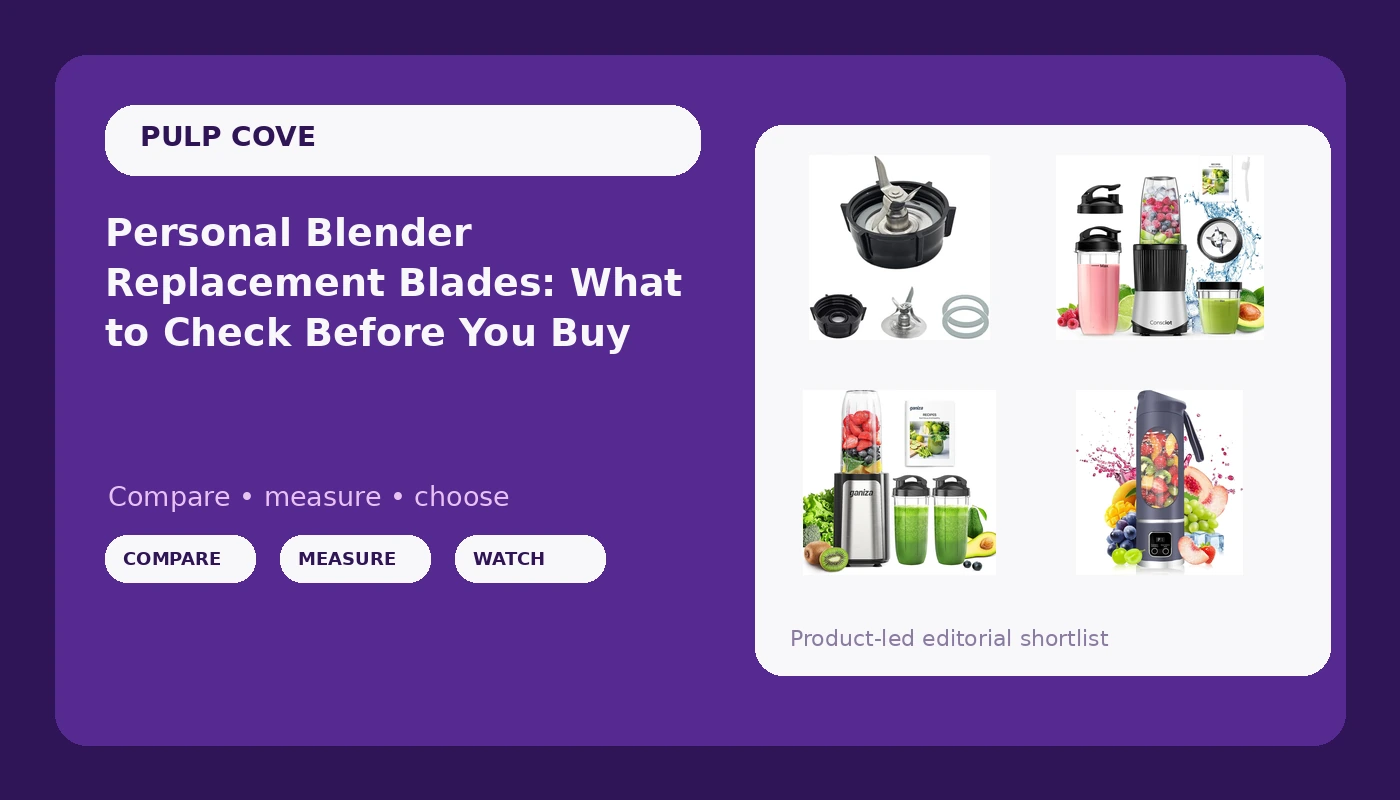
This guide is about telling those two situations apart before you spend. It covers a personal blender replacement blade kit built for Oster machines, two portable blender sets, and a compact USB-C model, and it explains what each one is actually for.
Related: How to Keep Frozen Fruit From Turning Your Smoothie Into Slush →
Quick answer
Match the fix to the failure, not to the marketing copy. If the motor still runs at full speed and the jar is intact but the texture has gone chewy, a replacement blade and seal kit is the cheap fix. If the cup wobbles on the base, the machine is loud enough to bother a neighbor, or you want a second, smaller blender for shakes and single servings, a personal blender is the better spend. None of the four options below is universally the quietest, fastest, or best. Each one solves a different problem, and the right pick depends on what is actually broken or missing in your kitchen.
Four useful options
| Model | Best fit | What stands out |
|---|---|---|
| for Oster Blender Replacement Parts Blender Ice Blade with Jar Base Cap and Two Rubber O Ring Seal Gasket Accessory Refresh Kit | Reviving a blender whose motor still works | Ice blade, jar base cap, and two rubber O-ring seals in one kit |
| Consciot 11-Piece Blender for Kitchen and Personal Size, 900 Peak Watts | One machine for both countertop and to-go blending | 11-piece set rated at 900 peak watts |
| Ganiza Smoothie Blender, 14Pcs Portable Personal Blender Shakes & Smoothies | Shakes and smoothies away from home | 14 pieces in a portable personal blender set |
| Personal Blender 500ml, USB-C, Ice Crush | Single servings and travel | 500ml cup, USB-C connection, ice crush claim |
The repair-first pick: Oster blade and gasket refresh kit
A refresh kit is the cheapest route back to a smooth smoothie, and it is also the easiest purchase to get wrong. Fitment is everything. The listing states that these parts are for Oster blenders, and within a brand, jar sizes and base threads can differ between models, so confirm the kit matches the machine you actually own before ordering. The three wear items here map neatly onto the three ways a working blender starts disappointing you. A dull blade leaves chunks. A flattened O-ring lets liquid seep toward the base. A damaged base cap turns a good jar into a leaky one. What a kit does not change is everything else: motor strength, noise, and jar capacity stay exactly where they were.
The all-in-one pick: Consciot 11-Piece Blender
Peak watts deserve a plain explanation, because the number on the box is not the number the motor holds for a full minute. Peak wattage describes a brief spike, typically at startup or under a hard load. It tells you the machine has some punch for frozen fruit and ice, and very little about how it behaves on blend forty. The 11-piece count is the more practical detail. Piece counts are mostly cups, lids, and blade assemblies, which means the set is really about how many drinks you can prep before you have to wash anything. That is genuinely useful for two people with different morning routines, and it is genuinely annoying if your cabinets are already full. More pieces means more storage, more washing, and more parts to lose.
The portable pick: Ganiza 14-Piece Smoothie Blender
Personal blenders trade capacity for convenience, and that trade is usually worth it for one person. The catch is where the wear shows up. On this style of machine, the connection between the cup and the base takes the abuse, not the pitcher, and a cup that starts wobbling is telling you the mating surfaces have worn. Fourteen pieces sounds like a lot until you count what they are: cups, lids, and blade assemblies, with a few accessories. The practical question is whether you want that many cups in rotation or whether three would do. Before you trust any small blender with your mornings, check two things yourself: how loud it is at full power, and how solidly the cup locks onto the base.
The compact pick: Personal Blender 500ml, USB-C
USB-C in a blender listing usually points to charging over a USB-C connection rather than a fixed wall cord, which changes where the machine can live: a desk, a dorm room, a hotel room, a car with the right adapter. What it does not change is physics. Five hundred milliliters is one generous serving, and small jars have less headroom above the blades, so overloading is the fastest way to a stalled blend or a popped lid. Treat the ice crush claim the way you would treat any ice crush claim: frozen cubes and frozen fruit are the hardest thing a small motor ever sees, and the only meaningful test is your own freezer, your own fruit, and your own first blend.
Prices and availability may change. Product images, names, and retailer links are matched to verified listings. No current price, rating, stock status, or measured result is stated here without current evidence.
Why blades dull and why your smoothie turns chewy
A blender blade is a piece of steel with an edge, and edges wear. Every frozen strawberry, every ice cube, and every dry scoop of protein powder takes a little off that edge. Dulling is gradual, which is exactly why it is so confusing. Nobody wakes up to a blender that stopped working. They wake up to a blender that still sounds completely normal and produces a drink with texture. That texture, the chewy, gritty, not-quite-smooth result, is a blade problem far more often than it is a power problem.
The diagnostic order matters. Listen first. If the motor spins up to the same pitch it always did and the blade turns freely, the motor is probably fine, and you are looking at a sharpness or seal issue. Look at the O-ring next. A flattened or gasket with trapped pulp will not seal properly, and liquid creeping into the base is what kills small blenders over time. Then check the base cap and the jar threads. If those are intact, a replacement blade and seal kit restores the part that actually failed and costs a fraction of a new machine. If the motor grinds, smells hot, or surges, no kit will save it, and it is time to replace the appliance.
There is one more variable people miss: heat. Long runs warm the drink, and warm smoothies taste flatter than cold ones. Short, hard bursts with a pause in between get you a colder result than one long continuous run, and they are gentler on the machine.
Reading the spec sheet: watts, pieces, and USB-C
Peak wattage is the number manufacturers lead with because it is the biggest number available. It measures a spike, not sustained output, so a 900 peak watt blender and a 900 running watt blender are not the same machine. Use wattage as a rough signal that a motor has enough torque for frozen ingredients, then weigh the things the spec sheet does not advertise: how the cup attaches, how loud the base is, and how many parts you have to wash.
Piece counts work the same way. An 11-piece set and a 14-piece set are not ranked by size; they are describing how many cups, lids, and blade assemblies come in the box. More pieces means you can prep several servings before washing, and it also means more cabinet space and more parts to keep track of. For one person making one smoothie a day, a big piece count is mostly storage. For a household with two different routines, it is genuinely useful.
USB-C is a connector, not a performance rating. It tells you how the machine charges. Capacity tells you how much it blends. The two are unrelated, and a small jar is a small jar regardless of how it gets power.
- Identify what actually failed: motor, blade, seal, jar, or base cap.
- If the motor runs and the texture is the problem, price a replacement blade and gasket kit before a new machine.
- Confirm the kit matches your specific model, since jar sizes and base threads vary within a brand.
- Count your real daily servings and choose capacity from that number, not from the biggest jar available.
- Measure your counter and cabinet space before buying a multi-piece set, then decide whether you want a repair, a replacement, or a second smaller machine.
Practical guidance before you buy
- Wash gaskets separately and dry them fully. Trapped pulp and moisture are what shorten a seal's life.
- Never run a blade dry and never use the blade assembly as a scraper.
- Fill to the marked line and tamp stubborn ingredients down instead of adding more liquid to force them under.
- Keep a retired jar as a backup container; the jar usually outlives the blade and the seal.
- Verify fitment by model before ordering parts, and confirm the return window in case the threads do not match.
- Test noise and cup fit on the first day, while returning is still easy.
Which option should you choose?
Choose the for Oster Blender Replacement Parts Blender Ice Blade with Jar Base Cap and Two Rubber O Ring Seal Gasket Accessory Refresh Kit when the motor still runs strong, the jar is intact, and the only thing wrong is the texture or a slow leak. Choose the Consciot 11-Piece Blender for Kitchen and Personal Size, 900 Peak Watts when you want one base that covers a larger blending job and a to-go cup, and you have room to store the extra pieces. Choose the Ganiza Smoothie Blender, 14Pcs Portable Personal Blender Shakes & Smoothies when shakes and smoothies are the whole job and you want a compact set with plenty of cups. Choose the Personal Blender 500ml, USB-C, Ice Crush when single servings and charging convenience matter more than batch size.
Peak wattage, piece counts, capacity, and compatibility statements here come from the product listings, not from independent measurement. No machine in this guide is being called the quietest, the fastest, or the best, because those claims require testing that this article does not present. Check the listing against your own model and your own routine before you buy, especially for replacement parts, where fitment is the entire purchase.
The bottom line
The cheapest blender upgrade is usually a blade. If your machine still sounds normal and your smoothies have gone chewy, start with a personal blender replacement blade and seal kit, confirm it fits your model, and see whether that solves it before you spend on a new appliance. If the motor is failing, the cup wobbles, or you never wanted a full-size pitcher in the first place, move to a personal blender instead. The Consciot set suits a household splitting one base between a kitchen jar and a to-go cup. The Ganiza set suits shakes and smoothies with plenty of cups in rotation. The USB-C model suits one serving at a time and a machine that can charge away from a wall outlet. Match the machine to your counter and your actual mornings, and check the current Amazon price on whichever one fits.