Every personal blender promises a smooth smoothie in seconds. That promise is true exactly once: on the first blend, with a fresh blade and a cup you have not overloaded yet.
I make smoothies twice a day and I have for years, first as a nurse grabbing breakfast before a 6 a.m. shift and now behind the six stools at Pulp Cove, the smoothie stand I opened after I quit. A personal blender for smoothies is not just a small version of a big blender. It is a different machine with a different failure mode. The connection between cup and base wears, the blades dull, and somewhere around blend 25 your drink goes from velvety to chewy. I call that grainies, and a machine that gets there early does not get recommended on this site.
Here is the six-point test I run, the two personal blenders currently worth your counter space, and the order to do it all in.
Why you should trust me
I spent eight years in the ER blending two smoothies a day, one fruit in the morning and one vegetable in the afternoon, because I wanted the fiber and not a juice. Then I quit and turned that habit into a job. On a Saturday rush the stand pushes out 40 smoothies before 9 a.m., and that rush is the stress test no forum thread can replicate: a liquid-diet customer who needs a protein shake in 30 seconds flat, a line of tickets, one sink, and no patience for a cup that wobbles on its base.
Along the way I learned the things the spec sheets leave out. My first cheap machine died inside a month. A Magic Bullet sounded like a jet engine in my apartment and my neighbor knocked on the door to ask what it was. A mid-range Ninja crushed ice beautifully until the smoothies started coming out chewy and I had to admit the blades were done. That log, plus a decibel meter and a notebook of which parts actually come apart for cleaning, became this site.
My rules are simple. No recommendation without a first-blend frozen fruit and ice test. No noise claim without a meter reading at full power. No blade durability claim without 25 logged blends. No dishwasher-safe claim until I have checked every part myself, including the base.
How I picked and how I tested
I do not shop by wattage or by the number on the box. I shop by six questions, in this order.
- Does it crush frozen fruit and ice with no chunks on blend one?
- Will it still be smooth at blend 25, or does it turn to grainies?
- How loud is it at full power, and would a neighbor complain through a wall?
- Does a 60-second run heat the drink up or whip it full of air?
- Can it handle a full cup without the lid popping?
- Do all the parts come apart, and are they dishwasher safe?
Everything below is judged against that list. The texture question is the one that decides value, because a machine that costs half as much but quits being smooth at blend 30 costs you more per good smoothie than the machine that runs for two years. Portion size is the second question, and it is the one people skip. A 20-ounce cup is a real single serving. Anything bigger is a pitcher pretending to be personal, and a pitcher in a small kitchen is a curse.
The two personal blenders worth your counter space
Two machines, two different jobs. One is the entry point for a single glass in the morning. One is the daily driver I point people to when they blend every single day.
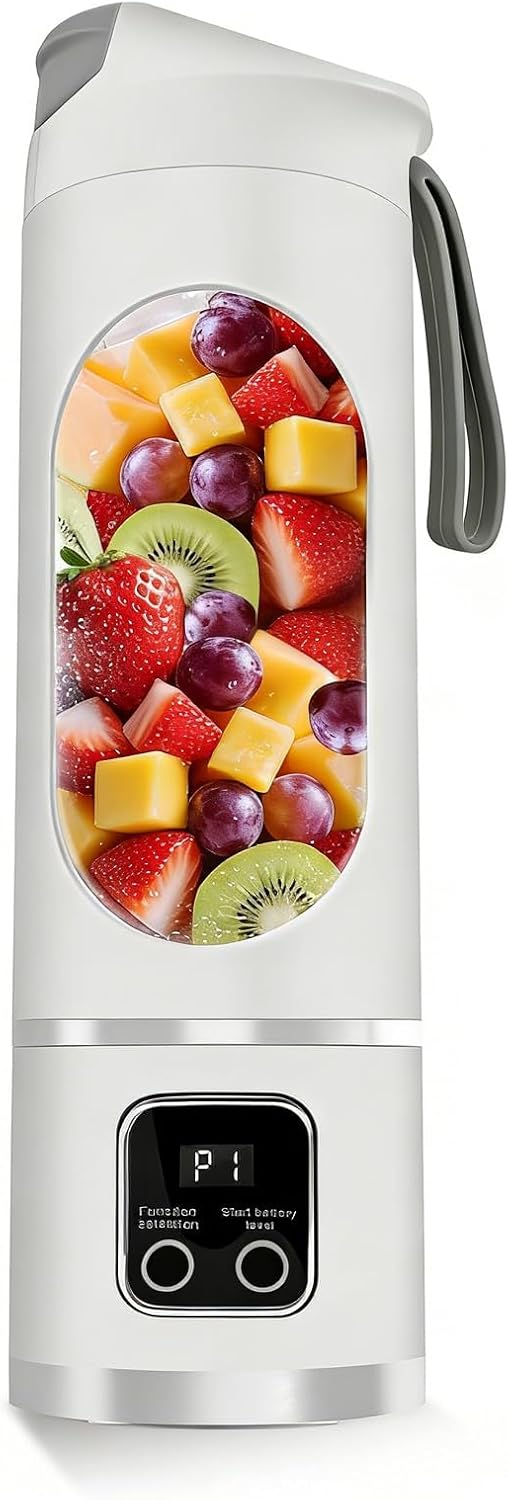
Budget pick: Personal blender, convenient personal juicer (White)
 Visit on Amazon →
This is the small-footprint option, and the listing positions it as two tools in one: a personal blender and a convenient personal juicer. In practice that means one machine for a morning smoothie and one for a glass of juice from soft fruit, which is exactly what a one-person kitchen wants when counter space is measured in inches.
Before you trust it with your mornings, verify the three things that fail first on budget machines. Press the cup onto the base and feel the connection points: if the cup wobbles now, it will wobble worse in three months. Run it empty for two seconds and listen, because cheap housings amplify motor noise and apartment walls do not stop a jet engine. Then take the blade assembly apart and wash it by hand the first time, so you know how it goes back together before you are rushed.
Flaws but not dealbreakers: At this price you are buying a single-speed, single-purpose machine, not a motor that laughs at frozen mango. Keep the loads small, add liquid first, and it does the job it was built for.
Check current Amazon price on the listing. If your routine is one glass, one fruit, one handful of ice, this earns its square of counter.
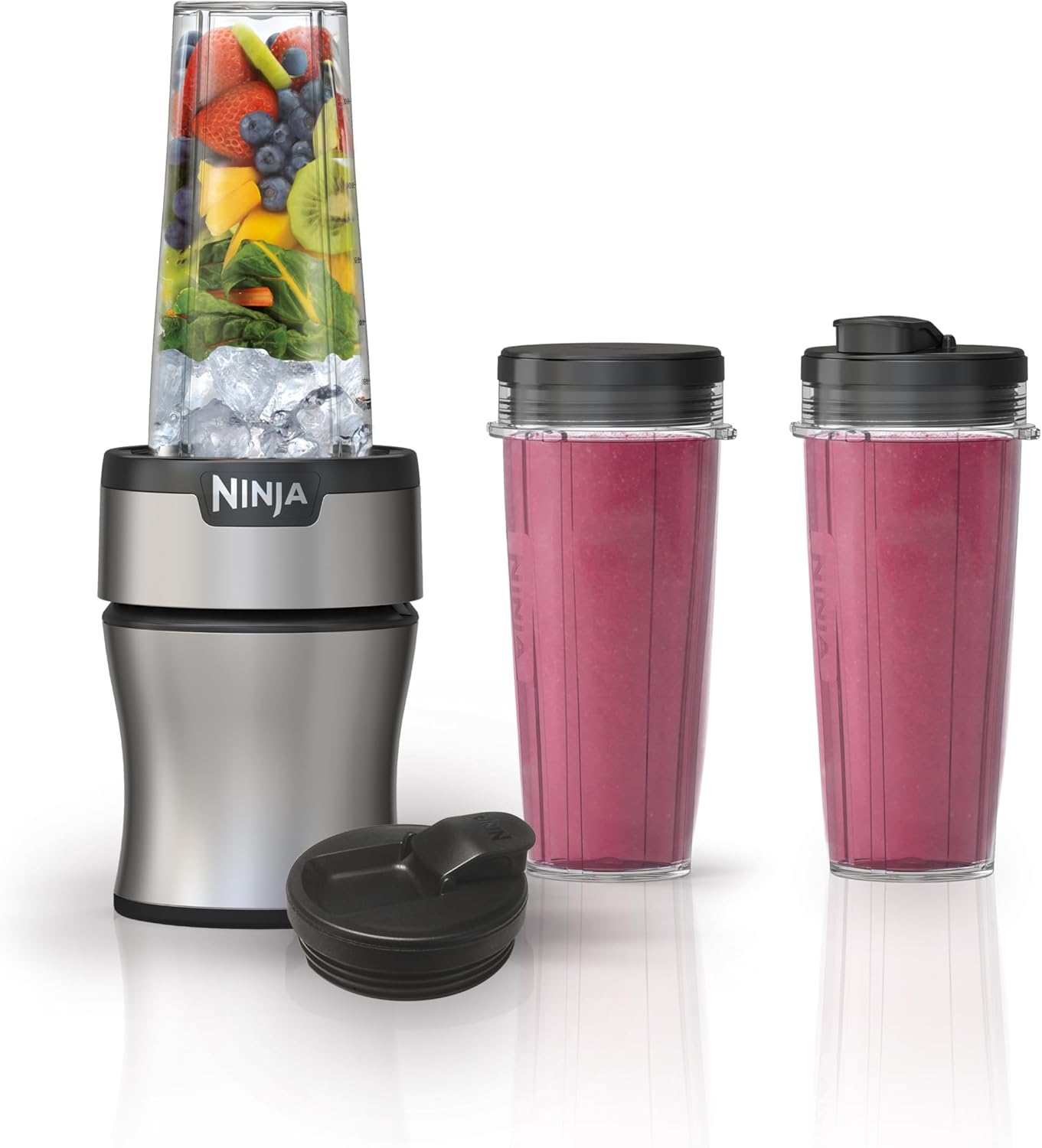
Our pick: Ninja Nutri-Plus Personal Blender, 900PW, (3) 20oz Cups, Silver, BN301
 Visit on Amazon →
This is the personal blender I hand to people who blend daily. The motor is a 900-peak-watt push-to-blend design built for smoothies and sauces, which means you press the cup down to run it and release to stop. That is the right control for a personal blender, because you are standing at the counter anyway and a dial you have to reset is just one more thing between you and breakfast.
The package is what sells it: three 20-ounce cups, two spout lids, and a storage lid. Three cups is not padding. It is batch prep and portion control in one purchase. Blend two cups back to back, cap one with a spout lid for the road and one with the storage lid for later, and you have solved two meals without washing a pitcher. The parts are dishwasher safe, which matters more than any marketing claim on the box, because the reason people stop using a blender is not the blending, it is the cleaning.
Push-to-blend has one honest downside: you cannot walk away and let it run while you pack a bag. You are holding the cup down for the whole blend. For 30-second smoothies that is fine. For someone who wants to load a machine and leave the room, it is the wrong tool.
Flaws but not dealbreakers: A 20-ounce cup is one serving, so a family of four is making four blends, not one. And the blades are blades. They dull, and the number of blends before they do is the number that decides whether this was a good purchase. Log it.
Check current Amazon price on the listing. For daily smoothie people who want three cups and a motor with real push behind it, this is the pick.
The steps: how to choose and how to run it
Now the part that matters, whether you buy one of the two above or something else entirely.
Step one: Count your cups before you shop. One person blending breakfast needs one 20-ounce cup, not a 72-ounce pitcher. A pitcher is a curse for a single person: it is harder to clean, it takes more counter space, and it tempts you into overloading it until the lid pops and smoothie goes everywhere. Buy for your actual routine, not for the Thanksgiving you host once a year.
Step two: Check the connection, not the wattage. The cup-to-base joint is the part that wears out first on any personal blender. Press the cup in and rock it gently. Any play at all today becomes a wobbling cup in a few months, and a wobbling cup means an uneven blend and a lid that leaks.
Step three: Run the first-blend test with frozen fruit and ice. Not a banana and milk. Frozen strawberries, a handful of ice, enough liquid to move. If you get chunks on blend one, walk away. Chunks on day one are a preview of grainies on day 40.
Step four: Log to blend 25. This is the number I care about most, and it is the number nobody advertises. Every blade dulls. The only question is whether it happens after 25 blends or after five years, and that gap is what you are actually paying for at the register.
Step five: Meter the noise at full power. Stand where you blend and take a reading, or at minimum run it at full speed and ask yourself whether you would do this at 6 a.m. with a neighbor on the other side of the wall. I do apologize to mine.
Step six: Run 60 seconds and taste for heat and aeration. Long runs warm the drink and whip air into it. If your protein shake comes out half foam, that is the machine, not the powder.
Step seven: Verify the dishwasher claim on every part. Not the cup. Every part, including the base if the listing says so. If the blade assembly traps pulp in a seam you cannot reach, you will stop using the machine within a month.
Then run it well. Liquid in first, then soft ingredients, then frozen fruit and ice on top. Do not fill past the line. Shake the cup rather than packing it down, and if a chunk stalls the blade, stop, shake, and start again instead of holding the button and hoping.
The competition and why it lost
Full-size machines are a different article. A 72-ounce pitcher with a big motor is the right answer for a family or a batch-cook Sunday, and it is the wrong answer for one person with 14 inches of counter. I have overloaded a big pitcher and cleaned smoothie off the ceiling, so I know both sides of that argument.
Premium high-speed blenders are also a different article. They do not depend on sharp blades the way a personal blender does, which is why they keep going when a cheap machine has gone grainy, but they cost several times more, they foam your drink more than you expect, and they are not something you carry to the car.
Centrifugal juicers and juicer-blender combos belong to the juice guide. They are fast and fine for oranges and watermelon, and a simple reamer beats a big electric machine if all you need is one glass of citrus at breakfast. That is a countertop real estate decision, not a blending decision.
This guide is about the small machine on the counter that has to make one smoothie, every morning, without turning chewy.
What this all costs
Value is not the sticker price. It is the price divided by the number of velvety smoothies you get before the texture goes. Run that math on any personal blender before you buy it. A machine that dies at blend 30 costs more per good smoothie than one that runs for two years, even at twice the price.
Both listings above carry a live price, so check current Amazon price on each one rather than trusting a number in an article, including this one. Then add the small stuff that decides whether you actually use it: a second cup so one is always clean, a lid you can drink from in the car, and a brush small enough to get under the blade.
The machine is the cheap part. The habit is the expensive part, and it only survives if the cleaning takes 30 seconds and the smoothie comes out smooth every time.
That is the whole test. Pick the machine that fits your counter and your routine, run it to blend 25 before you decide it was money well spent, and let your mornings stay velvety.