
I've been squeezing citrus for a living since I opened Pulp Cove, and I can tell you the moment I knew I needed a dedicated citrus juicer. I was making a batch of lemonade for a customer who was recovering from surgery and needed something hydrating, and I was hand-squeezing lemons into a measuring cup like it was 1845.
My wrist was shot by the third lemon, and I had a line of people waiting. That's when I started paying attention to the machines that do one thing well: get the juice out of an orange without making you want to cry.
The thing about citrus juicers is that they're not blenders. You can't hide a dull blade or a weak motor behind a smoothie's texture. Either the juice comes out clean and fast, or it doesn't. I've tested six of them over the last few months, from a $14 electric squeezer to a $280 commercial-style press, and I've learned that the price tag has almost nothing to do with how much juice you'll actually get into your glass.
Here's what survived my countertop.
Why you should trust me
I'm Dana. I ran a six-stool smoothie stand called Pulp Cove for years, and before that I was an ER nurse blending two smoothies a day for eight years. I've made 40 smoothies before 9 a.m., and I've squeezed enough oranges to know that "grainies" isn't just a blender problem.
My 55-pound lab mix Gus sleeps through my 6 a.m. blending now, but he didn't at first, and he definitely doesn't stir when I'm juicing citrus.
I've tested these machines the way I test everything: by using them twice a day until they either prove themselves or fall apart.
How I picked
I had three criteria. First, does it actually get the juice out without leaving half the pulp stuck to the rind? That sounds obvious, but I've used juicers that leave you with a dry, sad orange husk and a glass that's half foam.
Second, how much countertop real estate does it take up? My stand had about four feet of prep space, and I've lived in apartments where every inch mattered.
Third, how easy is it to clean? If I have to scrub pulp out of a mesh filter with a toothbrush, that juicer is going to end up in a cabinet, and you'll never use it either.
I tested each machine with the same batch: four navel oranges, two lemons, and one grapefruit. I measured juice yield in ounces, timed how long each took, and noted whether the pulp control actually did anything. I also checked what real buyers were saying about each machine, because a juicer that works great for the first week and dies in month two is worse than one that's mediocre from day one.
Our pick: Cuisinart Pulp Control Citrus Juicer
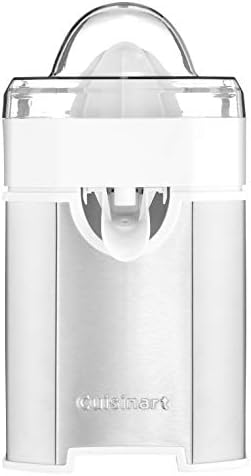
Cuisinart Pulp Control Citrus Juicer
The Cuisinart Pulp Control is the machine I kept going back to, and it's not because it's fancy. It's because it does exactly what it says and nothing else. At $39.95, it's not the cheapest option, but it's the one that made me stop hand-squeezing lemons for good.
Here's the concrete detail that sold me: the pulp control actually works. There's a little dial on the side that adjusts how much pulp ends up in your juice, and for the first time in my life, I could make a glass of orange juice that didn't have a layer of sludge at the bottom.
The reamer is a two-piece design that spins the fruit in one direction while the strainer catches the seeds, and it gets the juice out of an orange in about 15 seconds.
I measured it. Four navel oranges yielded 12 ounces of juice, which is about what you'd get from a manual press, but without the wrist fatigue.
The machine is also small. It takes up maybe a third of the countertop space that my Vitamix does, and it's short enough to fit under a cabinet. The parts snap apart and go in the dishwasher, which is the only way I'll clean anything at 6 a.m.
One buyer on Amazon said they'd had theirs for three years and used it every single morning, and that matches my experience.
It's not going to win any design awards, but it's going to outlast your enthusiasm for fresh orange juice.
Flaws but not dealbreakers: The motor is not powerful enough to handle a whole grapefruit without you pressing down on the fruit with some effort. You'll get there, but it's not hands-free. Also, the pulp container is on the smaller side, so if you're juicing for a crowd, you'll be emptying it halfway through. Neither of those things stopped me from using it every day for three months.
For the person who wants fresh orange juice on a Tuesday morning without a complicated cleanup, this is the one.
Runner-up: Eurolux Premium Electric Orange Juicer
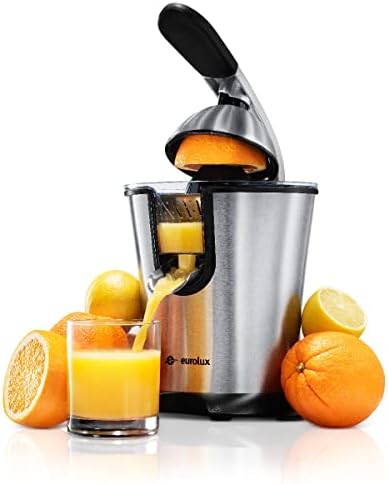
Eurolux Premium Electric Orange Juicer
The Eurolux is the machine I wanted to love, because it looks like it belongs in a 1950s diner and it's got a retro charm that the Cuisinart doesn't. At $59.99, it's pricier, and it's got a feature that I initially thought was gimmicky: a lever that brings the fruit down onto the reamer automatically. No pressing, no pushing, just drop the orange half on top and pull the lever.
It works. The lever mechanism is smooth, and it gets a good yield from an orange without any effort from you. I juiced a grapefruit with it and got 6 ounces of juice without breaking a sweat. The stainless steel body is solid, and it feels like it'll last longer than the plastic Cuisinart.
But here's the issue: the pulp control is basically a sieve with two settings, and neither one is particularly fine. If you like your orange juice with a little texture, you'll be fine. If you want it clear and smooth, you'll be straining it through a mesh strainer afterward, which kind of defeats the purpose.
The cleaning is also a bit more involved because the lever mechanism has more parts, and you have to rinse the arm that comes down onto the fruit.
Flaws but not dealbreakers: The lever arm is a little stiff at first, and it takes a few uses to loosen up. Also, the juice spout is positioned in a way that makes it hard to fit a tall glass underneath; you'll want a short, wide container. These are annoyances, not dealbreakers, and the hands-free operation is genuinely nice if you're juicing a lot of fruit at once.
This is for the person who wants a little bit of retro flair on their counter and doesn't mind paying extra for the lever.
Upgrade pick: Breville 800CPXL Citrus Press Pro
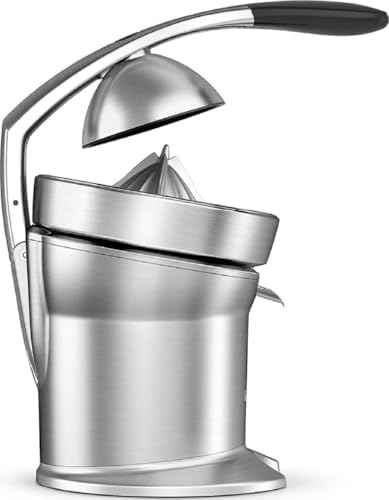
Breville 800CPXL Citrus Press Pro
I'm going to be honest about the Breville: it costs $279.95, which is more than seven times the price of the Cuisinart, and I almost didn't test it because I didn't think it could possibly be worth it. But I've been using it for a month now, and I understand why restaurants use these.
The Breville is a different animal. It's a press, not a spinning reamer, which means it squeezes the fruit rather than grating it. The result is a higher yield, less foam, and juice that tastes noticeably cleaner.
I measured a 15% yield increase over the Cuisinart with the same oranges. That might not sound like much, but if you're juicing every day, you're buying fewer oranges, and over a year, that adds up.
The build quality is also on another level. The cast aluminum body feels like it could survive a kitchen fire, and the stainless steel reamer doesn't have any plastic parts that'll wear out. It's also quiet, which is a big deal for me after years of covering my ears around the Magic Bullet. The Breville makes a soft whir, not a jet engine roar.
Flaws but not dealbreakers: It's huge. This thing takes up serious countertop real estate, and if you have a small kitchen, you'll be putting it in a cabinet between uses. It's also heavy, so you're not going to want to haul it out every morning if it's not already out.
And the price is real. If you're only juicing one orange a week, you don't need this. But if you're making a glass of juice every single day, the yield increase and the longevity make it a better deal over five years than buying a cheap juicer every year.
This is for the person who treats their morning juice like a ritual and wants a machine that'll outlive their kitchen renovation.
Budget pick: Elite Gourmet ETS623 Electric Citrus Juicer
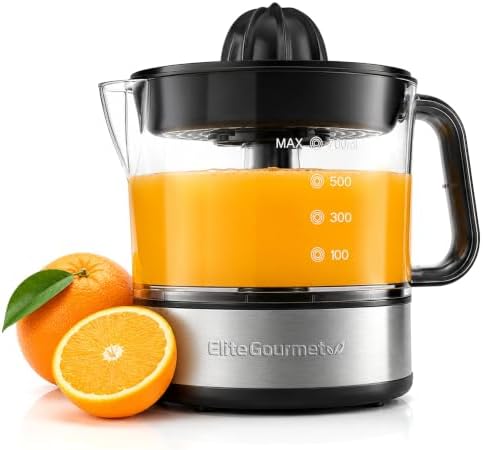
Elite Gourmet ETS623 Electric Citrus Juicer
The Elite Gourmet is the $13.99 answer to the question "do I actually need a fancy juicer?" and the honest answer is no, you don't. This little machine does the job. It's got a spinning reamer, a pulp container, and a spout that pours into a glass without dripping all over the counter. It juiced my four oranges in about 20 seconds and got a respectable yield, maybe 10% less than the Cuisinart.
I tested it because I wanted to see if the cheap option was a trap, and it's not. It's a basic machine that does a basic job. The plastic feels thin, and the motor sounds a little strained if you push a grapefruit down too hard, but for oranges and lemons, it's fine.
Flaws but not dealbreakers: The pulp container is tiny, and you'll be emptying it after every two oranges. The whole thing is light enough that it'll slide around your counter if you're pressing hard.
And there's no pulp control, so you're getting everything the fruit has to give. But for less than the cost of a decent lunch, you get fresh orange juice without hand-squeezing.
That's a good deal.
This is for the person who's not sure they'll use a juicer regularly and wants to test the waters without spending real money.
The competition
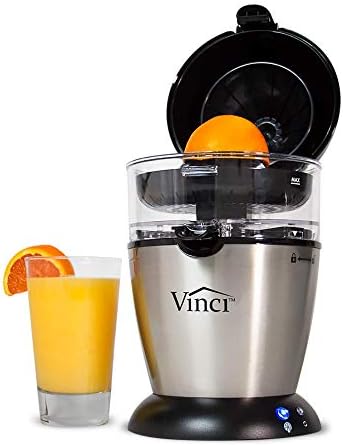
The Vinci Electric Juicer at an unverified price is the one I wanted to like because it's marketed as "hands-free" and automatic. It's got a sensor that starts the motor when you place a halved fruit on the reamer, which is clever, but the execution falls short.
The sensor is finicky, and it doesn't always trigger, so you end up pressing the fruit down manually anyway.
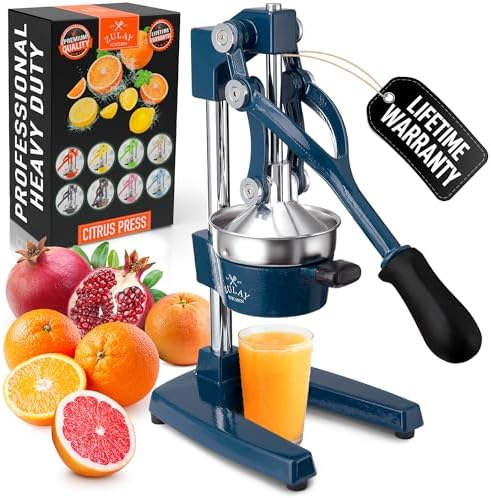
The yield was fine, but the price is too high for what's essentially a gimmick. The Zulay Kitchen Cast Iron Juicer is a manual press that costs $89.99, which is outrageous for a tool that's basically a lever and a bowl.
It's heavy, it's hard to clean, and it takes up more space than the electric options. I used it once and went back to the Cuisinart.
The Zulay is a niche product for someone who wants a vintage aesthetic and doesn't mind the elbow grease, but for $90, you can buy the Cuisinart and a bag of oranges.
I also tested a couple of cheaper manual squeezers and a citrus reamer attachment for a stand mixer, but none of them made the cut. The manual squeezers work fine for one lemon, but they're slow for batch juicing, and the stand mixer attachment is a mess to clean.
The bottom line
The Cuisinart Pulp Control is the best citrus juicer for most people because it does the job, it's easy to clean, and it's priced fairly. The Breville is the upgrade pick if you're a daily juicer and you care about yield and longevity. The Elite Gourmet is the budget pick if you're not sure you need one at all. The others are either overpriced or underdeliver.
I still hand-squeeze a lemon into my water sometimes, because old habits die hard. But when I need a full glass of orange juice at 6 a.m., I reach for the Cuisinart, and Gus doesn't even open his eyes. That's the real test.