Most blender failures are not motor failures. They are jar failures, lid failures, handle failures, and blade failures, and they tend to announce themselves at 6 a.m. with frozen fruit already sitting in the pitcher. When that happens, the useful question is not which blender is best. It is whether you need blender replacement parts or a whole new machine, and the answer depends entirely on which component actually stopped working. A cracked jar and a burned-out base look like the same problem from across the kitchen, but they lead to very different purchases.
Related: Why Smoothies Turn Grainy: Blade Dulling Explained →
Quick answer
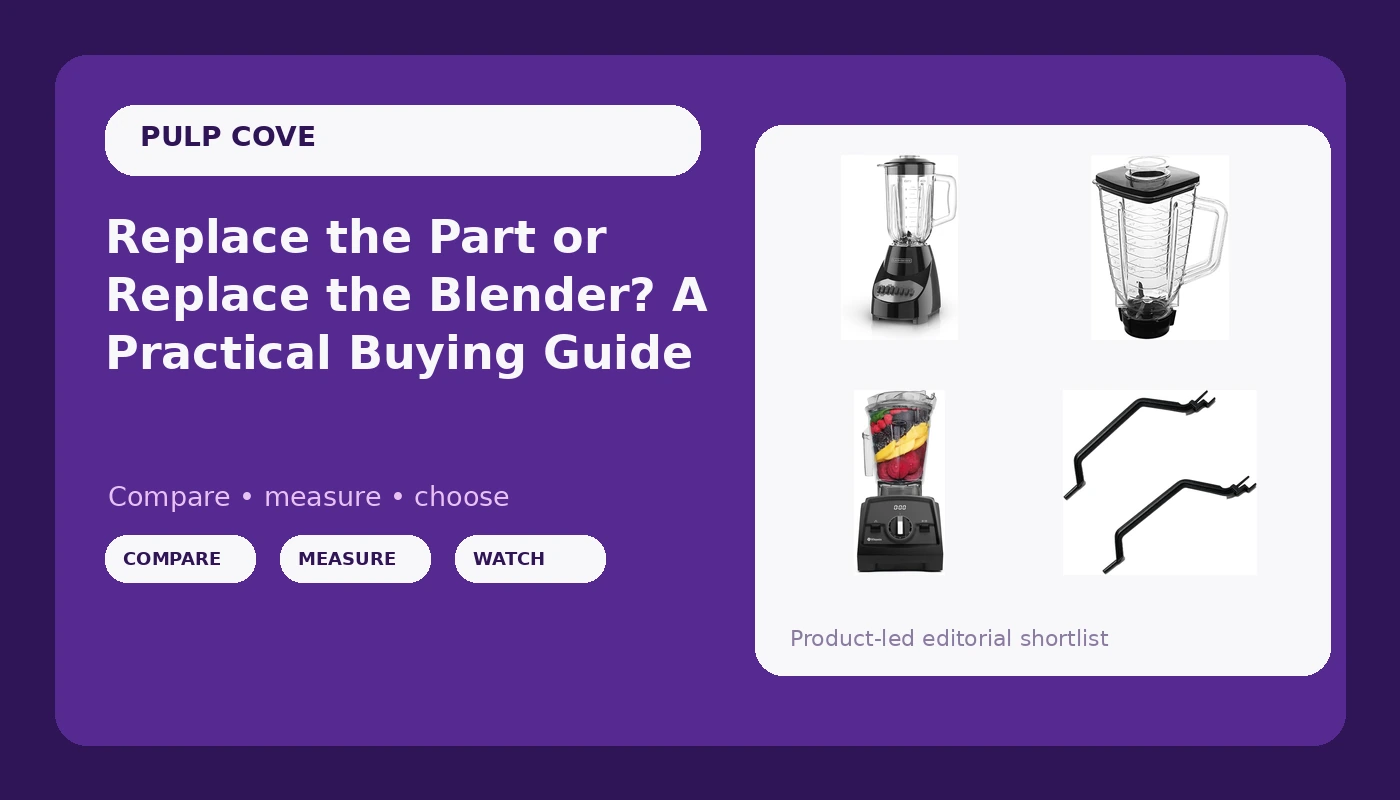
If the motor still runs and only the container, lid, handle button, or blade assembly has failed, a part is usually the faster and cheaper fix. The BLACK+DECKER BL2010BG covers everyday countertop blending with a 6-cup glass jar and 10 speed settings. The Vitamix Venturist Pro in renewed condition is the step up to a professional-grade machine with a 64 oz low-profile container. The Ninja-compatible handle button actuator and the Oster-compatible 5-cup jar are both part-level fixes for machines you already own. Buy a new blender when the motor, the speed control, or the base itself has failed, because no accessory part fixes a dead base.
4 useful options
| Model | Best fit | What stands out |
|---|---|---|
| BLACK+DECKER Countertop Blender BL2010BG | Everyday countertop blending | 6-cup glass jar with 10 speed settings |
| Vitamix Venturist Pro (Renewed) | Daily, high-volume blending | Professional-grade build with a 64 oz low-profile container |
| Handle Button Actuator for Ninja large containers | Reviving a Ninja pitcher whose button stopped engaging | A part-level repair instead of a whole new container |
| Replacement 5-Cup Square Plastic Jar with Lid for Oster | Replacing a cracked or missing Oster jar | 5-cup plastic jar with a lid included |
The everyday countertop blender: BLACK+DECKER Countertop Blender with 6-Cup Glass Jar
The trade-off here is capacity and container weight rather than features. Six cups is roughly a single large smoothie or two smaller ones, which is fine for a daily breakfast habit but tight if you like to blend a week of portions in one go. Glass is heavier to lift and pour than plastic, and it is the reason the jar feels substantial on the base. What you get in return is a container that does not cloud or hold onto the smell of yesterday's garlic dressing the way older plastic jars can. For someone replacing a dead entry-level blender, this is the machine that restarts the routine without committing to a premium price bracket.
The premium step up: Vitamix Venturist Pro Blender (Renewed)
The renewed label is the whole decision here. It typically means the machine has been through a previous owner and then refurbished, which is why the asking price sits below the new equivalent, and it is also why condition varies from listing to listing. Read the seller's description of what renewed includes before buying, and treat the container, lid, and tamper as things to confirm are present. On the plus side, a 64 oz low-profile container changes what a blender can do in a small kitchen: it holds a full batch without towering over the counter, and it fits under cabinets that a tall jar would hit. High-power machines like this also tend to be loud at full speed, so if your kitchen shares a wall with someone's bedroom, plan around that.
The repair part for a Ninja container: Handle Button Actuator Compatible With Ninja Blender Large Container
This is the classic case for repairing instead of replacing. When a Ninja pitcher stops running and the motor is clearly fine, the culprit is often the interlock button in the handle, the safety mechanism that tells the base a container is properly seated. If that button no longer depresses or springs back, the base has no reason to spin, and the blender looks dead when it is not. Before ordering, confirm two things: that your container is a large Ninja container this part fits, and that the handle on your specific pitcher is serviceable rather than sealed. Never bypass an interlock to force a blend. Replacing the actuator restores the safety function along with the blending.
The replacement jar for Oster blenders: Replacement parts 5-Cup Square Plastic Jar With Lid, Compatible with Oster Blenders
Jar replacement is the most common repair in a kitchen, and it is also where compatibility matters most. Plastic jars are lighter than glass, less likely to shatter when dropped, and easier to pour one-handed, but they can scratch over time and hold onto strong flavors if they are not washed promptly. Five cups is on the smaller side, so if your original Oster jar was larger, expect batch size to shrink. Check the base thread and the collar fit against your specific Oster model before ordering, because a jar that does not seat fully will not engage the base properly.
Prices and availability may change. Product images, names, and retailer links must be matched by verified ASIN. Do not state a current price, rating, stock status, or measured result without current evidence.
Why parts fail before motors do
The motor is usually the most durable thing in a blender, and it is rarely the reason a machine stops working. What fails first is everything the motor touches. Jars crack at the base or chip at the rim. Lids develop hairline splits and stop sealing, which is how a full pitcher ends up on the counter. Handle buttons lose their spring and stop telling the base a container is seated. Blade assemblies dull, and that failure is the sneakiest of all because nothing looks broken.
Dulling is gradual, which is why it takes people by surprise. A blade that has lost its edge does not stop cutting, it just stops cutting cleanly. Frozen fruit gets chopped into small chewy fragments instead of disappearing into a smooth liquid, and leafy greens come out as flecks. You start drinking smoothies with texture you did not ask for, and you blame the fruit. That is the point where a lot of people buy a new blender when they actually needed a new blade assembly or a new jar, and it is the point where a genuinely tired machine is worth replacing.
There is one more distinction worth knowing. Some high-power machines are built around motor speed, container geometry, and a strong vortex rather than a razor edge, which changes what blade sharpness even means for them. Entry-level machines lean much harder on the cutting edge itself. That difference is a big part of why the price gap exists, and it is why two blenders that look similar on a shelf can age very differently.
How to decide between repairing and replacing
The decision is a short checklist, and it is worth running it before you open a shopping tab.
- Identify the failed component. Turn the base on with nothing on it. If the motor spins, the problem is the container, the lid, the blade assembly, or the interlock button, and a part can fix it. If nothing happens, the base is the problem.
- Check whether the part is user-serviceable on your model. Some handles, collars, and blade bases unscrew or pop out. Others are sealed into the container, in which case the whole container is the part you need.
- Match the base model exactly before ordering. Container threads, collar sizes, and button shapes vary between models that share a brand name, and a part that almost fits is a part that does not fit.
- Compare the part against a new machine on what you gain, not just on cost. A replacement jar restores what you had. A new blender can change capacity, speed control, or container material.
- Weigh what you would lose. If your current jar, lid, and routine all work, a new machine means re-learning pour angles, batch sizes, and where the pitcher fits on the counter.
Matching the machine to your countertop and routine
- Measure both the counter footprint and the clearance under your upper cabinets before choosing a jar size. A low-profile 64 oz container exists precisely because tall jars hit cabinets.
- Six cups suits one or two servings. A 64 oz container suits batch blending for several days at once. Pick the size that matches how you actually blend, not the size that sounds more capable.
- Glass resists scratching and odor retention. Plastic is lighter and less likely to shatter. Neither is universally better; they fail differently.
- If your base still runs, price the container before you price a machine. A jar or a handle button is a small fraction of a new blender.
- Write down or photograph your base model number now, while the machine is working. It is the one detail you will need and the one you will not have when the jar finally cracks.
Which option should you choose?
Choose the BLACK+DECKER Countertop Blender with 6-Cup Glass Jar when you are replacing a dead entry-level machine and want a glass jar with adjustable speeds for daily single servings. Choose the Vitamix Venturist Pro Blender (Renewed) when you blend large batches often, want a professional-grade machine, and are comfortable buying in renewed condition to spend less than new. Choose the Handle Button Actuator Compatible With Ninja Blender Large Container when your Ninja base runs fine but the pitcher button no longer engages and your handle is serviceable. Choose the Replacement 5-Cup Square Plastic Jar With Lid when your Oster base is healthy and only the jar is cracked, chipped, or missing its lid.
Two caveats apply across all four. Renewed condition is not the same as new, and what a given listing includes should be confirmed with the seller before purchase. Compatibility parts depend on your exact base model, so verify the fit rather than assuming a brand name is enough.
The bottom line
Replace the part when the motor still runs and the failure lives in the container, the lid, the blade assembly, or the handle button. Replace the machine when the base is what died, or when you are ready to change capacity and container style along with it. A 6-cup glass jar blender handles everyday single servings, a renewed professional-grade machine with a 64 oz low-profile container handles batch blending, and the two repair parts keep a Ninja pitcher and an Oster jar in service for a fraction of the cost of starting over. Diagnose first, then buy.