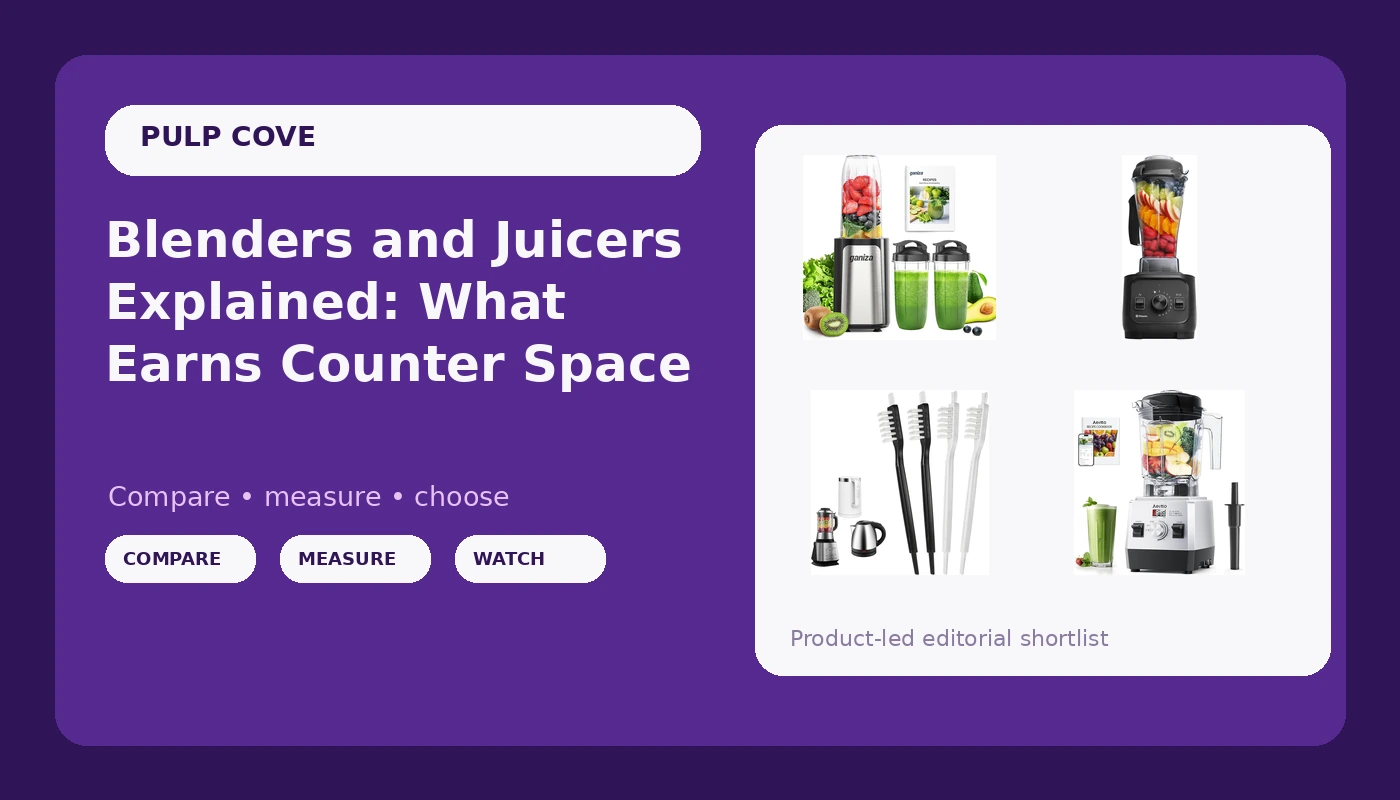
Buying a blender or a juicer usually gets framed as a power question. More watts, more speeds, more blades, more money. Spend a few mornings feeding frozen fruit and ice into a machine and the real question gets narrower: does this thing turn what you put in it into something you actually want to drink, and does it keep doing that next month? That gap between blend one and blend twenty-five is where most buying decisions are won or lost, and it is the part the box never explains. The blenders and juicers below sit at different points on that curve, from a 14-piece personal set to a professional-grade machine to a four-piece brush kit that keeps the small parts from becoming a science project.
Related: How to Keep Frozen Fruit From Stalling Your Blender →
Quick answer
There is no single machine that wins for every kitchen, because the right answer depends on batch size, counter space, and how often you blend. If you blend for two or more people at once, a full-size countertop blender with a large pitcher is the practical choice. If you make one shake at a time, a personal blender takes less space and less cleanup. If you want one footprint doing two jobs, look at a machine that covers both blending and juicing, and plan for cleaning tools either way, since buildup in crevices is what quietly shortens the life of any machine. Match the format to your routine first, then compare the specs inside that format.
Four useful options
| Model | Best fit | What stands out |
|---|---|---|
| Aeitto Blenders for Kitchen with 68Oz. Large Capacity, 1800W Max Power Smoothie Blender, 3 Preset Programs & 7 Speeds, Professional Countertop Blender for Smoothies, Ice Crush, Generation 1 Silver | Households blending for two or more | 68 oz pitcher, 1800W max power rating, 3 preset programs plus 7 speeds |
| Vitamix VX1 Professional-Grade Blender, 64 oz. Container, Black | Daily blenders who want a long service life | Professional-grade positioning and a 64 oz container |
| Ganiza Smoothie Blender, 14Pcs Portable Personal Blender Shakes & Smoothies | Single servings and small kitchens | 14-piece personal set built around portable cups |
| 4 PCS Juicer Cleaning Brush, Crevice Small Blender Cleaning Brush for Cleaning Small Parts, Juicer Cleaning Brush for Omega 8006, Vrt, 8004, 8003 Vert Vrt350 Vrt330 Masticating Juicers | Anyone cleaning juicer or blender parts | Four brushes sized for small and hard-to-reach parts |
The balanced countertop pick: Aeitto Blenders for Kitchen with 68Oz. Large Capacity, 1800W Max Power Smoothie Blender, 3 Preset Programs & 7 Speeds, Professional Countertop Blender for Smoothies, Ice Crush, Generation 1 Silver
This is the shape most people picture when they say blender: a pitcher you fill, a lid you lock, a dial or a button you press. The 68 oz capacity is the number that matters most here, because it decides whether you are blending one smoothie or four. A pitcher this size is genuinely useful for batch prep, Sunday meal prep, and families where everyone wants a different fruit combination in the same half hour. It is also the size that punishes carelessness. Fill a large pitcher past its line with frozen fruit and you are asking the lid to hold back a smoothie that wants to leave, and the fix is not a stronger lid, it is a smaller load and a tamp down rather than an overload. If you live alone and drink one shake a day, this format is more counter space and more cleanup than you need, and a personal blender will serve you better. If you cook for more than one, the capacity pays for itself immediately.
The premium workhorse: Vitamix VX1 Professional-Grade Blender, 64 oz. Container, Black
The argument for this tier is not that it makes a better smoothie on day one. A well-built mid-range machine can produce a velvety frozen fruit blend on the first run. The argument is what happens after a year of daily use. Machines at this level are engineered around motor output and airflow rather than around a blade edge that has to stay razor sharp forever, and that distinction is the whole point of paying a multiple of the mid-range price. There are trade-offs worth naming. High-output blending whips air into the drink, so you should expect more foam on top, and long runs add heat, which matters if you are blending something you plan to drink cold. Programs on premium machines also tend to run longer than a manual blitz, which is why people who own one often still reach for a faster machine on a rushed morning. If you blend once a week, this is more machine than your routine will use. If you blend twice a day, it is the version of this purchase you only make once.
The personal blender: Ganiza Smoothie Blender, 14Pcs Portable Personal Blender Shakes & Smoothies
Personal blenders live or die on two things, and neither one is on the spec sheet. The first is the connection point where the cup meets the base. That interface takes every bit of torque the motor produces, and it is the part that wears, which is why a cup that wobbles or a collar that no longer seats is usually the beginning of the end for these machines. The second is noise. A personal blender is small, not quiet, and the motor sits inches from your hand with very little housing around it. Before you commit one to a 6 a.m. routine, think honestly about what is on the other side of your wall. The upside of the format is real: you blend into the cup you drink from, so cleanup is one vessel and one blade assembly instead of a pitcher, a lid, and a tamper. For a single person in a small kitchen, that trade is often worth more than raw power. Just do not expect a 14-piece kit to replace a full-size machine for batch work, because it will not.
The maintenance kit: 4 PCS Juicer Cleaning Brush, Crevice Small Blender Cleaning Brush for Cleaning Small Parts, Juicer Cleaning Brush for Omega 8006, Vrt, 8004, 8003 Vert Vrt350 Vrt330 Masticating Juicers
This is the least exciting item in the guide and the one that most often decides how long the others last. Pulp and fiber pack into the seams of a juicer screen, the underside of a blade assembly, and the collar where a cup threads onto a base. Left there, that residue dries into something that smells and that eventually affects how parts seat. A dedicated crevice brush reaches places a sponge cannot, and a four-piece set covers the range from a wide screen to a narrow gasket channel. If you own a masticating juicer, this is close to mandatory rather than optional, because those machines have more small parts than a blender and far more surface area for fiber to hide. Buy it at the same time as the machine, not after the first time you spend twenty minutes failing to rinse a screen clean.
Prices and availability may change. Product images, names, and retailer links are matched to verified listings. No current price, rating, stock status, or measured result is stated here without current evidence.
Blade wear is the quiet variable
Watts get printed in large type. Blade condition does not get printed anywhere, and it is the thing that changes your smoothie most over time. A sharp edge cuts frozen fruit and ice cleanly at relatively low speed. As that edge rounds over, the machine has to rely on blunt force, and blunt force on frozen fruit produces a different texture: not chunks exactly, but a slightly chewy, fibrous drink that never quite smooths out no matter how long you run it. Call it grainies. Once a blender reaches that stage, more time in the jar does not fix it, and no amount of wattage compensates, because the problem is geometry rather than power.
This is the single most useful lens for pricing a blender. A cheaper machine is not a scam; it is a machine with a shorter useful window on the blade. The honest question is how many velvety blends you get before the texture changes, and whether the price difference between two machines is smaller or larger than the cost of replacing the cheap one twice. Machines built around motor output rather than blade sharpness push that window out further, which is what the premium tier is actually selling.
The practical takeaway is not to baby your blades, but to stop making them do unnecessary work. Do not run a blender dry to scrape the jar. Do not load ice first and fruit on top; liquid and soft ingredients belong at the blade so the hard stuff gets pulled down into motion rather than hammered. Rinse promptly, because dried residue on a blade edge is abrasive in a way that wet pulp is not.
How to choose without guessing
The mistake people make is comparing machines across categories. A personal blender is not a worse full-size blender; it is a different tool with a different job. Decide on the format first, then compare within it.
- Count your typical batch size. One serving points to a personal blender. Two to four servings points to a full-size pitcher in the 64 to 68 oz range.
- Measure your counter. A full-size machine claims permanent real estate. If you do not have the inches, that is a decision, not a detail.
- Decide whether you are blending, juicing, or both. If you juice greens regularly, a masticating juicer does more extraction work than a centrifugal machine, and it comes with more parts to clean.
- Think about your mornings honestly. If you blend before 7 a.m. in an apartment, noise is a real constraint, and small machines are not automatically quiet ones.
- Budget for maintenance on day one. A brush set costs less than a replacement part and prevents the buildup that causes most early failures.
What to check before you buy
- Confirm the pitcher or cup capacity against the number of people you actually serve, not the number you might serve at a party.
- Check whether the parts you will wash are listed as dishwasher safe, and check every part rather than the jar alone.
- Look for whether the lid locks and whether the manufacturer describes an overload limit, since lids pop on overloaded pitchers.
- For personal blenders, inspect the cup-to-base connection in reviews and photos, because that interface is the failure point.
- For juicers, confirm that the machine can be fully disassembled, since a juicer you cannot take apart is a juicer you will stop using.
Which option should you choose?
Choose the Aeitto Blenders for Kitchen with 68Oz. Large Capacity, 1800W Max Power Smoothie Blender, 3 Preset Programs & 7 Speeds, Professional Countertop Blender for Smoothies, Ice Crush, Generation 1 Silver when you blend for more than one person and want a large pitcher with preset programs alongside manual speeds. Choose the Vitamix VX1 Professional-Grade Blender, 64 oz. Container, Black when you blend daily and would rather pay once for a machine positioned for long-term service than replace a mid-range unit every couple of years. Choose the Ganiza Smoothie Blender, 14Pcs Portable Personal Blender Shakes & Smoothies when you make single servings, want to drink from the cup you blended in, and can live with the noise and the cup-to-base connection that define the format. Add the 4 PCS Juicer Cleaning Brush set when you own a juicer or a machine with narrow parts, because cleaning access is what keeps everything else working.
One caveat applies to all four. Specifications on a listing describe a machine, not your kitchen. Capacity, noise, blade life, and cleaning difficulty all depend on what you blend, how full you fill it, and how promptly you wash it. Treat the numbers here as the starting point for your own comparison, and check current listings for the details that matter to you.
The bottom line
The right blender or juicer is the one that matches your batch size, your counter, and your tolerance for noise and cleanup. A full-size machine with a large pitcher handles household volume. A professional-grade unit is a bet on longevity rather than a shortcut to a better first smoothie. A personal blender wins on footprint and cleanup for one person. And a cheap brush set protects the investment you already made, which is the least glamorous and most reliable advice in this guide. Pick the format that fits your routine, then compare specs inside it. That order is what keeps you out of the grainies.
Check current Amazon price on each listing before you commit, since availability and pricing move and the only number that matters is the one in front of you today.