Smoothie blenders are sold on a promise that sounds simple: frozen fruit and ice go in, something velvety comes out. The hard part is keeping that promise past the first week. Motors heat up, blades lose their edge, jars crack, and lids pop when a pitcher gets overfilled. A machine that felt impressive on day one can start leaving small chewy flecks in your drink by the time you have made a few dozen batches, and almost none of that shows up on a spec sheet.
Related: Blender vs Juicer: Which One Earns the Counter Space →
Quick answer
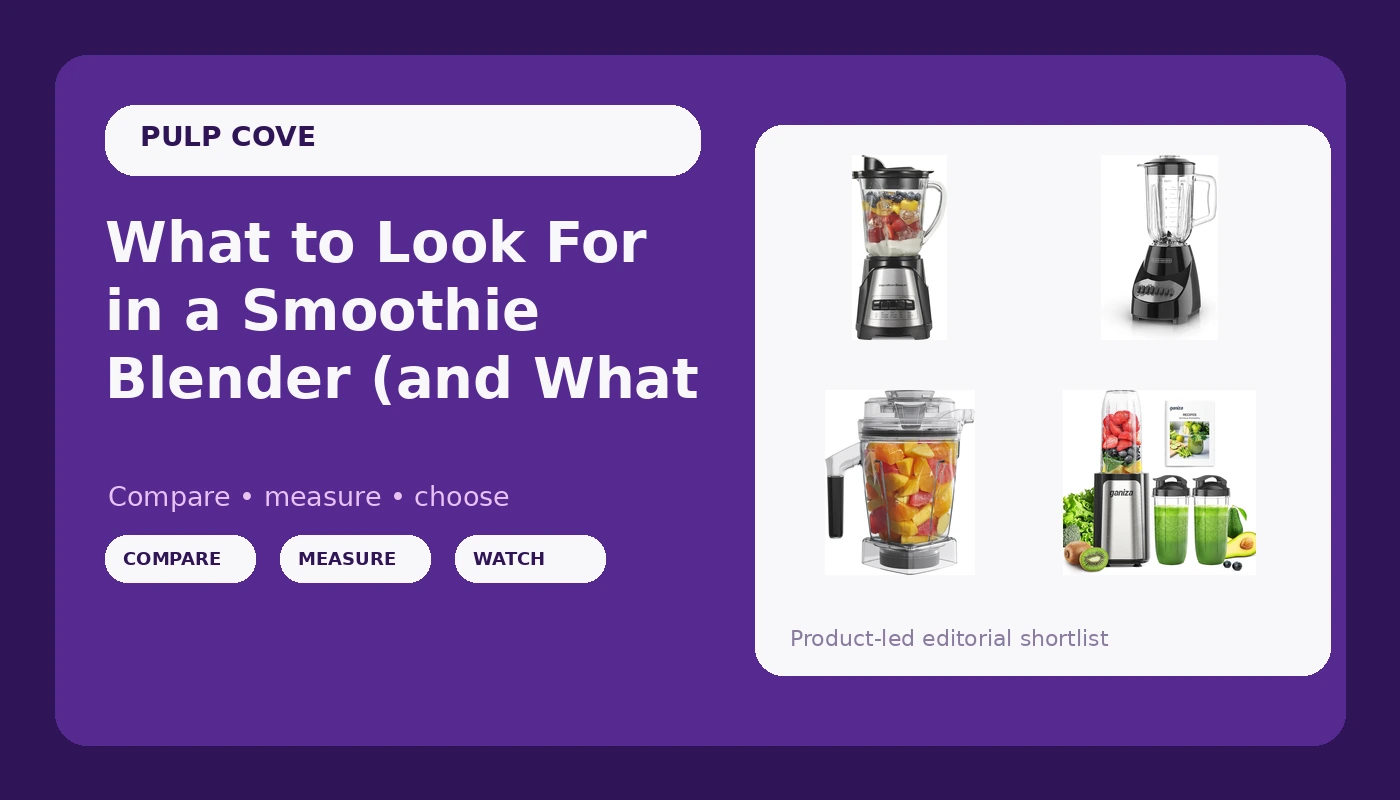
The right smoothie blender depends on volume and routine, not on a single winner. For full-size pitchers at a modest price, the Hamilton Beach Power Elite and the BLACK+DECKER 10-speed model are the mainstream options, and the BLACK+DECKER is the one with a glass jar. For single servings and small kitchens, a personal set like the Ganiza covers shakes and smoothies in a fraction of the footprint. And if you already own a compatible Vitamix base, the 48 oz. container is not a new machine at all, it is the upgrade that changes how much you can blend at once.
Four useful options
| Model | Best fit | What stands out |
|---|---|---|
| Hamilton Beach Power Elite Blender For Smoothies With Wave Action System | Everyday full-size blending on a budget | Wave Action System designed to keep ingredients moving instead of clinging to the jar |
| BLACK+DECKER Countertop Blender with 6-Cup Glass Jar, 10-Speed Settings, Black, BL2010BG | Buyers who want a glass jar and real speed control | 6-cup glass jar plus 10 speed settings |
| Ganiza Smoothie Blender, 14Pcs Portable Personal Blender Shakes & Smoothies | Single servings, small kitchens, drinks on the go | A 14-piece set built around personal blending |
| Vitamix 48 oz. Blender Container with SELF-DETECT, BPA-Free Tritan | Existing Vitamix owners who want a second or larger container | SELF-DETECT container, 48 oz., BPA-free Tritan |
The full-size starting point: Hamilton Beach Power Elite Blender For Smoothies With Wave Action System
The case for a full-size budget pitcher is simple: it does the volume a personal cup cannot, and it leaves you enough money to replace it if it does not last. The trade-off is the thing nobody prints on the box. Every cutting blade dulls with use, and a budget machine typically reaches that point sooner than a premium one. When it does, the symptom is not a dramatic failure. It is texture. Frozen berries stop disappearing completely, and you start noticing small chewy bits in what used to be a smooth drink. That is the real clock on a cheap blender, not the wattage number.
The glass jar option: BLACK+DECKER Countertop Blender with 6-Cup Glass Jar, 10-Speed Settings, Black, BL2010BG
Glass is the detail that separates this one from most pitchers in its bracket. Plastic jars scratch, and scratches hold onto color and odor over time, which matters if you blend greens in the morning and berries in the afternoon. Glass also feels heavier in the hand, and it is heavier in the sink, so if you have ever dropped a jar while rinsing it, that is worth weighing. The ten speeds are the other half of the story. Smoothies do not need ten speeds, but they do benefit from being able to slow the blades down for softer ingredients and speed them up for frozen ones, instead of relying on a pulse button and hope.
The compact personal option: Ganiza Smoothie Blender, 14Pcs Portable Personal Blender Shakes & Smoothies
Personal blenders live and die on two things that are not the motor: the connection between the cup and the base, and the noise. The cup-to-base connection is a wear item. It is usually plastic on plastic, and after enough twists it loosens, the cup starts to wobble, and the seal stops being reliable. Noise is the other hidden cost. A personal blender running at full power in a small kitchen is loud in a way that a full-size pitcher somehow is not, because the motor sits inches from the counter and the cup acts like a small speaker. If you live in an apartment with thin walls, run one before you commit to a 6 a.m. routine.
The premium container upgrade: Vitamix 48 oz. Blender Container with SELF-DETECT, BPA-Free Tritan
It is worth being blunt about what this listing is, because the price looks like a blender and the box is not one. If you do not already own a compatible Vitamix base, this container does nothing for you. If you do, it is often the most efficient upgrade available: a second jar means you can keep one clean and dry for dry blends and one for wet, or size up when you are blending for more than one person. Tritan is the middle ground between glass and cheap plastic, lighter than glass and more resistant to scratching than the plastic jars on budget machines. The honest caveat is that premium bases earn their reputation through speed and airflow rather than through razor-sharp edges, which also means they tend to whip more air into a drink. If you want a dense smoothie rather than a foamy one, that is a real adjustment.
Prices and availability may change. Product images, names, and retailer links are matched to verified listings. No current price, rating, stock status, or measured result is stated here without current evidence.
How a blender actually makes a smoothie smooth
Three things decide whether frozen fruit disappears or turns into flecks, and only one of them is the motor.
The first is the cutting edge. Most budget blenders rely on sharp blades to slice through frozen chunks. Sharp works, and sharp is why a new inexpensive blender feels impressive. But edges dull with use, and a dull blade does not cut, it batters. That is where the chewy texture comes from: fruit that got smashed into small pieces instead of sliced cleanly. There is no maintenance routine that brings an edge back on a sealed blade assembly, so on a budget machine, blade life is effectively the machine's life.
The second is power and speed. A high-powered machine can create a strong vortex that pulls ingredients down into the blades and keeps them circulating, which means it can blend partly through force and velocity rather than relying entirely on a keen edge. That is the structural argument for spending more: less dependence on a part that wears out.
The third is airflow and heat. Every blender whips some air into the jar, and longer blends whip in more. More air means a foamier, less dense drink, and it is the reason a protein shake can come out half froth. Longer runs also warm the mixture, which is fine for soup and unwelcome in a smoothie. Short, efficient blends taste better than long, lazy ones, which is an argument for a machine that finishes the job fast.
Jar size, material, and the full-batch problem
Capacity numbers describe the container, not the drink. A 48 oz. jar does not hold 48 oz. of smoothie, because a full jar has no room for the vortex that keeps ingredients moving. Fill a pitcher to the top and you get two outcomes: a stalled blend with powder stuck to the walls, or a lid that pops and a counter covered in smoothie. Leave headroom, and use a tamper if your machine came with one rather than adding more liquid.
Material is the second decision. Glass is heavy, stable, and does not stain or hold odors. Tritan and other quality plastics are lighter and less likely to shatter on a tile floor. Cheaper plastic scratches, and scratches trap color and smell. If you blend greens daily, that matters more than the spec sheet suggests.
Finally, check the parts before you trust a dishwasher claim. Jars, lids, blades, and gaskets are not always all dishwasher safe, and the base never is. A blender you have to hand wash in four pieces is a blender you will use less often, and frequency of use is what actually determines value.
- Count how many servings you blend in a normal week, not on your most ambitious day.
- Decide whether you need a pitcher for multiple servings or a cup for one.
- Measure the space between your counter and the upper cabinets before ordering anything tall.
- Confirm whether you are buying a complete machine or a component for one you already own.
- Run frozen fruit and ice on the first blend, and pay attention to the noise, while the return window is still open.
Practical guidance
- Buy for the routine you actually have. A 72 oz. pitcher is a burden for one person and a necessity for four.
- Treat blade life as the real price tag. A cheap machine that lasts one season is more expensive than a mid-range one that lasts three.
- Leave one third of the jar empty. Overloading is the most common cause of a popped lid.
- Judge noise before you buy if you can, and if you cannot, assume a personal blender in a small kitchen will be heard through a wall.
- Check that every removable part is dishwasher safe and that the jar, lid, and blade assembly come apart without tools.
- Plan for aeration. If you want dense smoothies, short blends beat long ones.
Which option should you choose?
Choose the Hamilton Beach Power Elite Blender For Smoothies With Wave Action System when you want one full-size countertop machine for daily smoothies and you would rather spend the difference on fruit than on hardware. Choose the BLACK+DECKER Countertop Blender with 6-Cup Glass Jar, 10-Speed Settings, Black, BL2010BG when you want a glass jar that will not stain and speed control you can actually use for softer blends. Choose the Ganiza Smoothie Blender, 14Pcs Portable Personal Blender Shakes & Smoothies when you blend one serving at a time, you are short on counter space, and cleanup speed matters more than batch size. Choose the Vitamix 48 oz. Blender Container with SELF-DETECT, BPA-Free Tritan when you already own a compatible Vitamix base and want a second or differently sized jar rather than a whole new machine.
A caveat worth repeating: capacity, wattage, and speed settings describe equipment, not results. They cannot tell you how a specific machine will handle your specific frozen fruit after a few months of daily use, and they cannot tell you whether the texture will still be where you want it later. The only reliable test is running your own ingredients through it early and often, while you can still change your mind.
The bottom line
A blender's job is narrow: turn frozen fruit and ice into something velvety, every time, for as long as possible. Everything else on the box is positioning. Spend according to how often you blend and how long you expect the machine to stay sharp, size the jar to the number of people you are actually feeding, and check the noise and the jar material before you commit counter space. If you blend daily and can stretch the budget, the premium path pays off over years. If you blend a few times a week, a mid-priced full-size pitcher or a compact personal set will do the job, and the money you save buys a lot of frozen mango.