Most buying advice about blenders for smoothies and frozen fruit is written about the box instead of the glass. Wattage climbs, pitcher sizes climb, the feature list gets longer, and the drink still comes out with frozen mango rattling around the bottom. The specs that actually decide whether a machine earns its countertop real estate are narrower than the marketing suggests: how aggressively the blades bite, how big a batch you really make, and how much noise you are willing to live with at 6 a.m.
Related: Why Your Smoothie Turns Chewy, and How to Fix It →
Quick answer
Match the machine to the batch, not to the spec sheet. If you blend for one person, a compact personal blender with a 16 oz cup covers almost every morning. If you blend for two or more, or you prep a week of smoothies at once, a full-size 72 oz pitcher on a 1000-watt base is the format to look at. Blade sharpness, not wattage, is what eventually turns a smoothie chewy, and it is the one number no listing prints. Decide the batch size first, then decide how much you want to pay for a blade assembly that stays biting.
Four useful options
| Model | Best fit | What stands out |
|---|---|---|
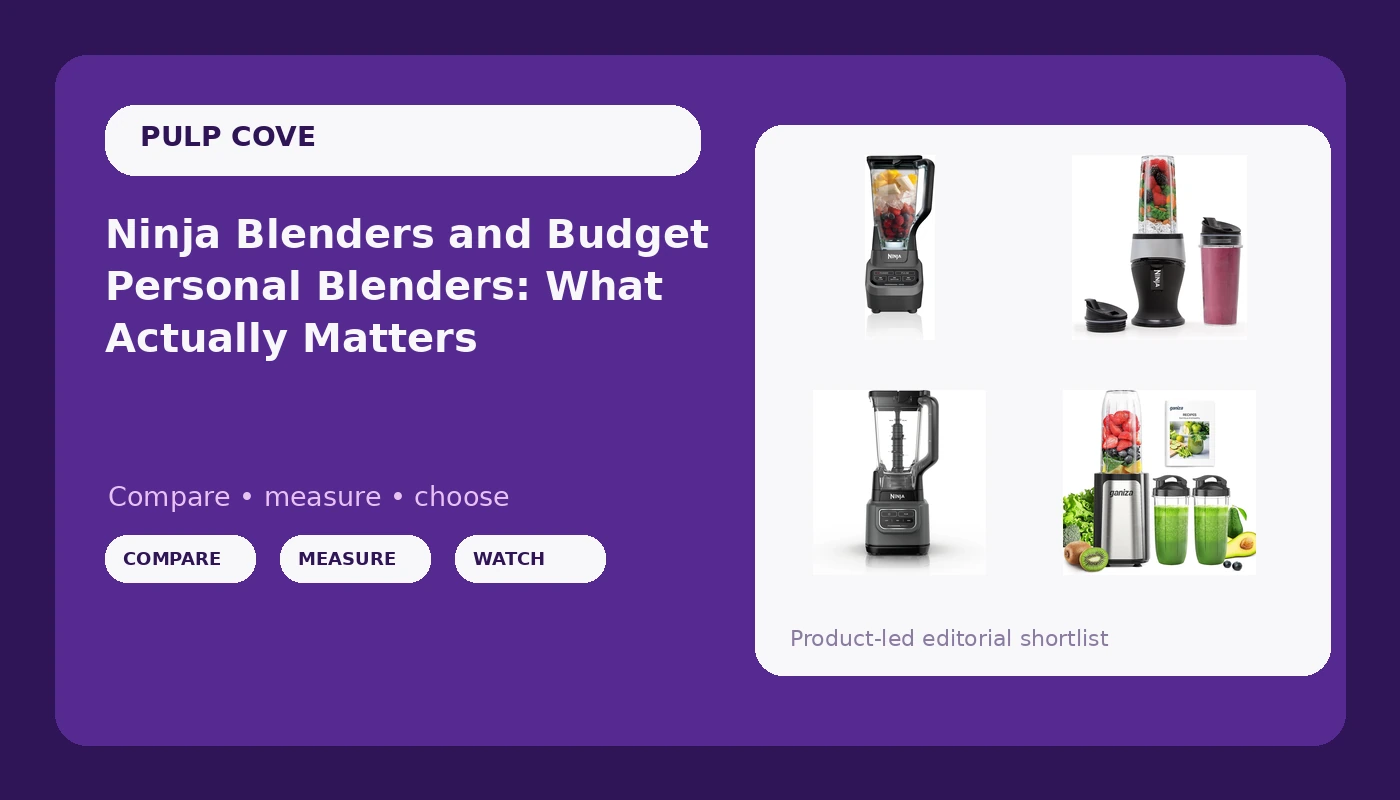
| Ninja Professional Blender, 1000W, Total Crushing Tech, 72oz Pitcher, BL610 | Households blending for two or more, or weekly batch prep | 1000-watt base, Total Crushing blade assembly, 72 oz pitcher |
| Ninja Fit Compact Personal Blender, 700W, (2) 16oz Cups, QB3001SS | One person, one cup at a time, small kitchens | 700-watt base with two 16 oz blending cups |
| Ninja Professional 72 Oz Countertop Blender with 1000-Watt Base and Total Crushing Technology for-Smoothies, Ice and Frozen Fruit, Black (Renewed) | Buyers who want the full-size Ninja format and accept a renewed unit | Renewed full-size Ninja with the same 1000-watt, 72 oz spec sheet |
| Ganiza Smoothie Blender, 14Pcs Portable Personal Blender Shakes & Smoothies | First blenders, dorm rooms, travel, and tight counters | Sold as a 14-piece set with portable cups and to-go lids |
The full-size value pick: Ninja Professional Blender, 1000W, Total Crushing Tech, 72oz Pitcher, BL610
This is the format that made the large Ninja a default recommendation in a lot of roundups: a big pitcher, a motor that does not stall on ice, and a blade stack designed to pull frozen fruit down into the cut instead of spinning on top of it. The trade-offs are the ones that come with size. A 72 oz pitcher is a curse for a single person, because you either make too much or you blend a small batch in a container that was built for a crowd. It is also a loud machine at full power, and loudness is not something you can fix after purchase. The other thing to plan for is blade life. Every blade dulls. On a large, affordable blender the interesting question is not whether the edge goes, but how many blends it takes, and whether you notice it as a slightly gritty texture before you notice it as chunks.
The personal-size option: Ninja Fit Compact Personal Blender, 700W, (2) 16oz Cups, QB3001SS
Personal blenders live or die on two things: whether the cup-to-base connection stays tight, and whether the machine is bearable at full power. The connection point is the wear item nobody talks about. On cup-style blenders, the interface between the blade assembly and the motor base is what loosens over months of daily use, and a wobbly cup blends unevenly before it fails outright. Check that interface before you commit to a personal blender, and check the noise. Two 16 oz cups also means portion control is built in, which matters if you have ever frozen a pitcher of leftovers because you made a full batch for one person. The honest limitation of this format is capacity: you are not making smoothies for a family, and you are not crushing a tray of ice in one go.
The renewed full-size option: Ninja Professional 72 Oz Countertop Blender with 1000-Watt Base and Total Crushing Technology for-Smoothies, Ice and Frozen Fruit, Black (Renewed)
This is the same format as the full-size pick above, which is exactly the point: if you want the 72 oz pitcher and the 1000-watt base and you are comfortable with a renewed unit, this listing is the alternative path to it. Renewed means the machine was returned and refurbished rather than built new, and the practical questions are the ones you would ask about any renewed appliance: what the listing says about condition, what the warranty covers, and whether the pitcher and blade assembly arrive complete. Do not assume a renewed unit ships with the same accessories as a new one. Read the condition notes on the listing, and if a warranty matters more to you than the format, buy new.
The budget portable kit: Ganiza Smoothie Blender, 14Pcs Portable Personal Blender Shakes & Smoothies
Budget personal blenders are the most common first purchase and the most common first disappointment, and the reason is rarely the motor. It is the claim on the box. "Smooth in seconds" is a statement about blend one, when the blades are new and the fruit is not frozen solid. What you want to know is how it behaves at blend twenty, with hard frozen fruit and a full cup, and that is the thing no listing will tell you. The bundle here is genuinely useful if you are outfitting a dorm room or a first apartment, since the cups and lids cover the to-go half of the job. Just temper expectations on texture: a small, inexpensive personal blender is a convenience machine, not a replacement for a full-size pitcher when you are working with dense frozen ingredients.
Prices and availability may change. Product images, names, and retailer links are matched to verified listings. No current price, rating, stock status, or measured result is stated here without current evidence.
Watts, pitcher size, and blade design: what each one changes
Wattage tells you how much work the motor can do before it stalls, and it matters most with dense loads: ice, frozen fruit, frozen banana, nut butters. It does not tell you how smooth the result will be. A 1000-watt base pushing a dull blade produces a worse drink than a 700-watt base pushing a sharp one, which is why the wattage race is a poor way to shop.
Pitcher size is a routine question disguised as a spec. A 72 oz pitcher is the right answer if you blend for two or more people or batch for the week, and the wrong answer if you blend a single serving, because a half-empty big pitcher lets ingredients ride up the walls instead of cycling into the blades. Cup-based personal blenders solve that by making the serving size the container size.
Blade design is the quiet variable. Ninja's Total Crushing assembly is built to pulverize ice, and it does that well when the edges are fresh. Centrifugal-style spinning blades and tall stacked blade columns both depend on sharpness and on enough liquid to keep ingredients circulating. Underfill the pitcher and the blend stalls; overfill it and the lid pops. Neither problem is a motor problem.
The durability question: what happens when the blades dull
Every blade dulls. The difference between an affordable blender and a premium one is often not whether the edge goes, but how long it takes and how gracefully the machine degrades. A dulled blade does not usually announce itself with a bang. It announces itself as texture: the smoothie that used to come out velvety starts coming out with a fine grit, then with actual chunks, and you find yourself adding liquid and blending longer to compensate. That is the moment people start shopping again.
If you want to judge a blender on durability rather than marketing, work through this:
- Identify your real batch size first, because blade load scales with volume, not with the number on the box.
- Check what the listing says about replacement parts, especially whether the pitcher and blade assembly can be bought separately.
- Look for whether the blade assembly is removable, since a fixed blade stack is harder to clean and harder to replace.
- Read the condition notes carefully if you are buying renewed, and confirm what the warranty actually covers.
- Decide how much you are willing to pay per year of use, not per machine, since a cheap blender that dies in a month costs more than a mid-range one that lasts years.
Matching the machine to your counter and your routine
- Measure the counter space before you measure the pitcher. A full-size blender needs clearance above it for the lid to come off, not just a footprint.
- Be honest about noise. If you blend before your household wakes up or you live in a thin-walled apartment, a full-power run is a real consideration, and no feature fixes it.
- Batch prep and single servings want different machines. If you make one smoothie at a time, a 16 oz cup is the whole job.
- Test the cup-to-base connection on any personal blender. That interface is the part that wears out first.
- Do not overload the pitcher to save a second blend. Lids pop, and the cleanup costs more time than the extra batch would have.
Which option should you choose?
Choose the Ninja Professional Blender, 1000W, Total Crushing Tech, 72oz Pitcher, BL610 when you blend for more than one person, batch smoothies for the week, or regularly crush ice in volume and want the full-size format new. Choose the Ninja Fit Compact Personal Blender, 700W, (2) 16oz Cups, QB3001SS when you make a single serving most mornings and want to drink from the cup you blended in. Choose the Ninja Professional 72 Oz Countertop Blender with 1000-Watt Base and Total Crushing Technology (Renewed) when you want that same full-size format and are comfortable with a renewed unit and its condition terms. Choose the Ganiza Smoothie Blender, 14Pcs Portable Personal Blender Shakes & Smoothies when you want an inexpensive, portable starter setup with to-go cups and you are realistic about texture on frozen ingredients.
One caveat applies across all four: none of these listings states a blade life, and blade life is what decides whether a blender is still pleasant to use in a year. Wattage, pitcher volume, and accessory counts are all verifiable from the listing. Durability is not, which is why the price you are willing to pay should reflect how much you trust the format rather than how impressive the spec sheet looks.
The bottom line
The blender that works is the one sized to your actual batch, quiet enough for your actual mornings, and cheap enough that you are not angry when the blades finally go. For most people blending for a household, that points at the full-size 72 oz, 1000-watt Ninja format, new or renewed depending on your appetite for condition terms. For most people blending for one, it points at a cup-based personal blender, and the Ninja Fit is the more established version of that idea while the Ganiza kit is the budget entry point with the accessories included. Check current Amazon price on the listing you are considering, confirm the condition and what ships in the box, and buy the format your routine can actually use.