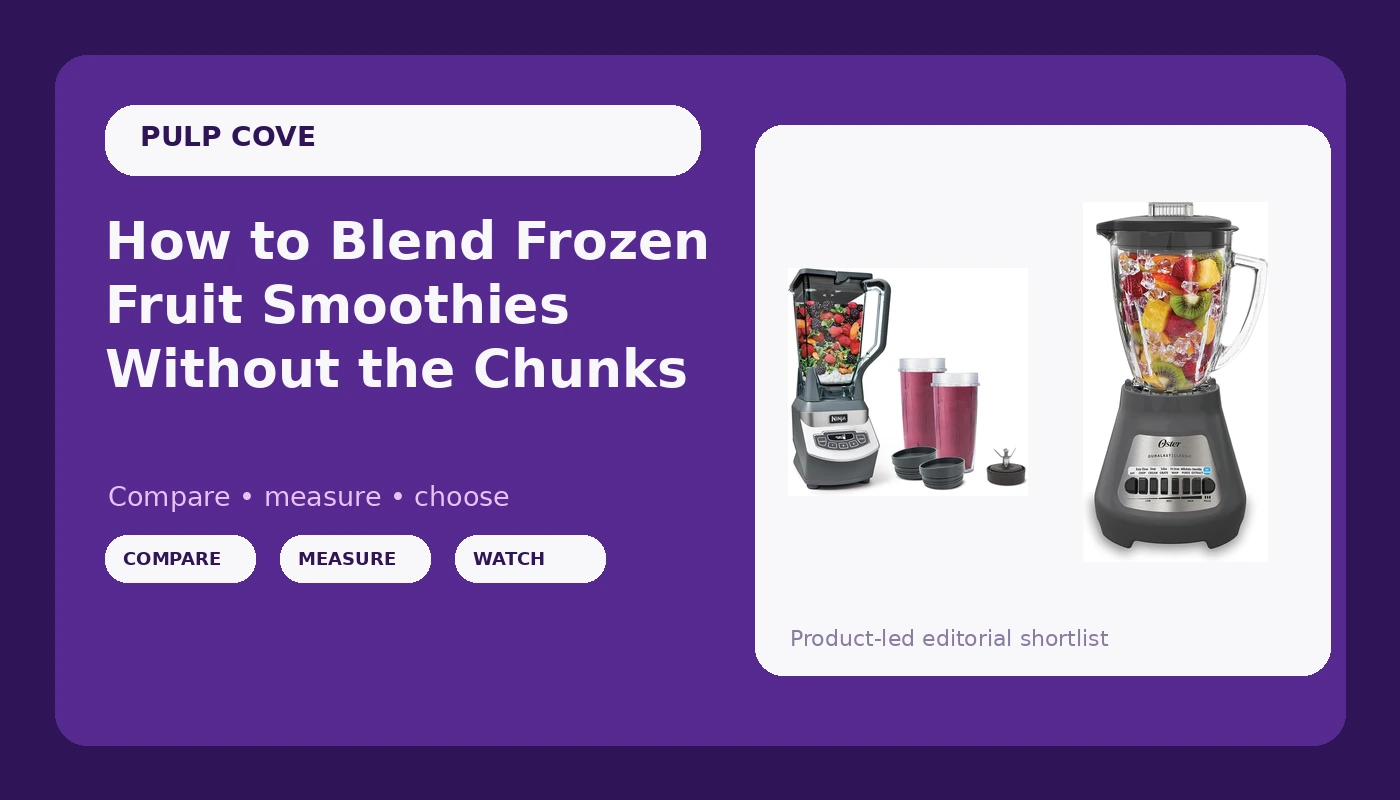
Most frozen fruit smoothies fail for the same boring reason: the fruit goes in frozen, the liquid goes in first, and the blades never get a clean bite on anything. You end up with a cup of slush and a strawberry shoulder stuck to the side of the jar. Learning how to blend frozen fruit smoothies is less about wattage than about order, load, and a little patience.
I blended my own breakfast and afternoon smoothie twice a day for years, first as an ER nurse who wanted fiber without stripping it out of the fruit, then as the owner of a six-stool smoothie stand called Pulp Cove. Somewhere in there, blenders stopped being appliances and became the tools of the job. I have popped lids, cooked bases, and tasted more chewy, half-crushed smoothies than I care to admit.
The method below is the one that fixed it, and it works the same way in a modest six-cup jar as it does in a big pitcher. The short version: frozen fruit in a ring against the jar, liquid last, pulse to break the fruit down, then run, and stop before the drink gets warm.
Why you should trust me
Eight years of twice-daily smoothies came before I ever sold one to a customer, and then the stand taught me what a home kitchen never could. I have made dozens of smoothies before 9 a.m. on a Saturday, which is the kind of volume that exposes a weak machine inside a week.
I also log what I blend. Every machine I run gets the same first-blend test with frozen fruit and ice, the same full-batch run to see whether the lid holds, and a noise check at full power, because "apartment friendly" is a marketing phrase until somebody has actually listened to it at 6 a.m. I taste for grainies, which is my word for what a smoothie becomes when the blades dull and the texture turns chewy instead of velvety. It is the single most useful thing I know about blenders, and it is why the checklist below exists.
What I check before I recommend any blender
Six things, in this order:
- Does it crush frozen fruit and ice with no chunks on the very first blend? If blend one has grit in it, nothing later matters.
- Does it still come out smooth deep into its life, or does it turn to grainies? Blades dull. Every blade dulls. The real question is whether that happens early or after years of daily use, and that number is what you are actually paying for.
- How loud is it at full power? Noise is a feature you pay for.
- Does a 60-second run heat the drink up? A warm smoothie is a bad smoothie.
- Can it take a full batch without the lid popping? Overload a pitcher and you will be wiping the ceiling.
- Does every part come apart, including the blade assembly and the gasket, so it can actually be cleaned?
The two blenders I would start with
You do not need a premium high-speed machine to follow the workflow below. You need a jar that fits your counter and your actual routine. These two cover the practical range, and both are shaped around the way frozen fruit really behaves.
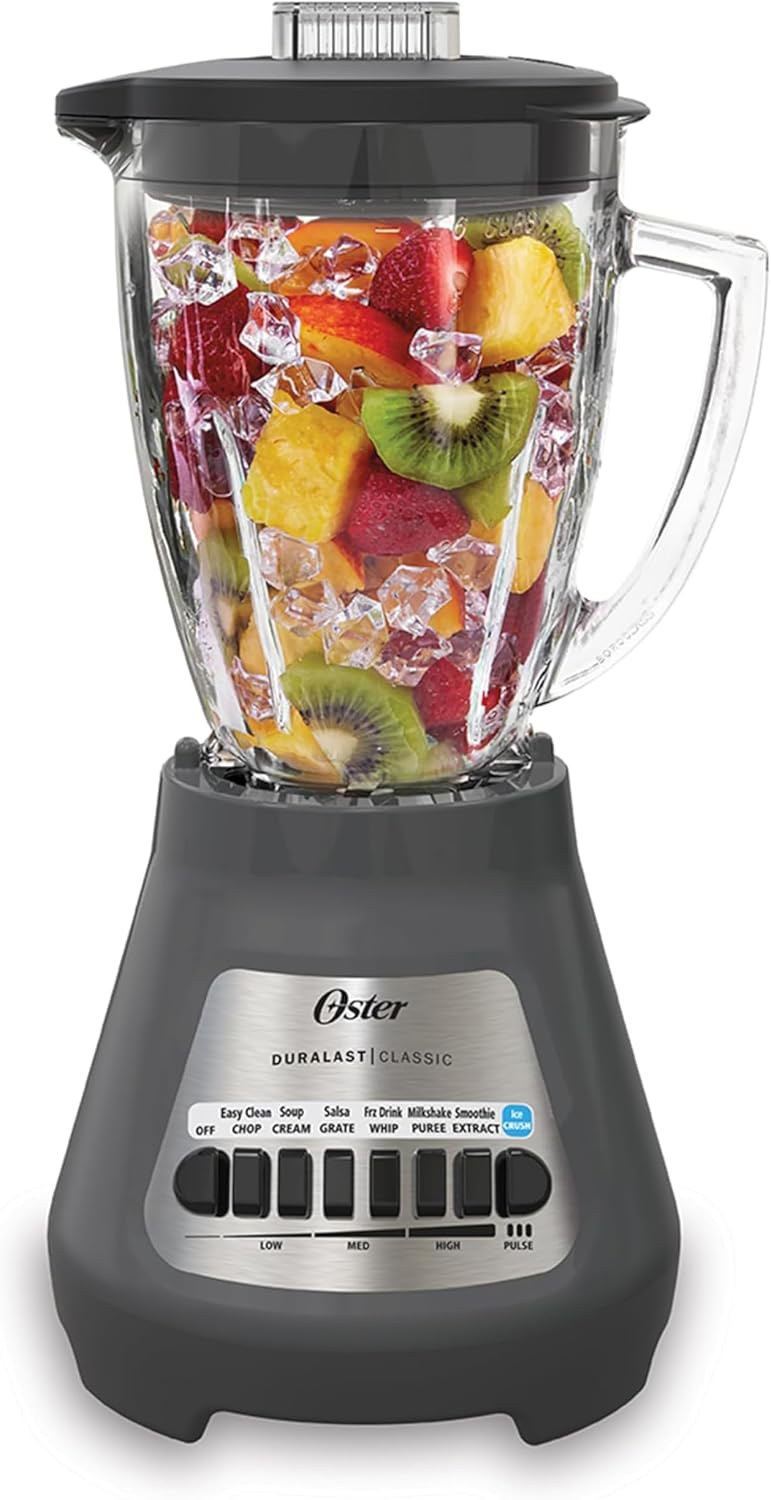
Budget pick: Oster® Classic Series 8-Speed Blender with 6-Cup Glass Jar, Gray
 Visit on Amazon →
The case for this one is the eight speeds and the glass jar. Manual speed control is not a gimmick when frozen fruit is involved: you want to start slow and break the fruit into a rubble, then step up as the mixture loosens. A machine with one button and a prayer gives you no way to do that. The glass jar is the other half of it. Glass does not cloud, does not scratch, and does not hold onto yesterday's garlic the way plastic does, which matters if you blend savory sauces in the same jar you blend breakfast in.
The six-cup jar is the honest part. This is a small-batch machine, and for one person making one or two smoothies a day, that is the correct size. A big pitcher is a curse for a single person: you either make too much or you blend a puddle at the bottom that never reaches the blades. This jar solves that by simply not being enormous.
Flaws but not dealbreakers: Glass is heavy, and a full jar on a light base needs a steady hand. If you blend for a family of four, you want the bigger pitcher below.
Anyone in a small kitchen, blending one or two servings at a time, who wants to control the speed by hand will be happy here.
Our pick: Ninja BL660 Professional Compact Smoothie & Food Processing Blender, 1100-Watts, 3 Functions -for Frozen Drinks, Smoothies, Sauces, & More, 72-oz.* Pitcher, (2) 16-oz. To-Go Cups & Spout Lids, Gray
 Visit on Amazon →
The 1100-watt motor and the 72-ounce pitcher are why this is the one I reach for when I am blending for a crowd or prepping a week of smoothies in one go. The three functions cover frozen drinks, smoothies, and sauces, so the jar earns more than just breakfast duty. The two 16-ounce to-go cups with spout lids are the part people underestimate: a personal cup that fits the same base means you blend straight into what you carry out the door, which is the difference between a smoothie habit that survives the week and one that dies on Wednesday.
Two cautions, both learned the hard way. First, that pitcher is huge. Overload it and the lid will pop, and you will be wiping smoothie off the cabinets. Fill to the line, not to the rim, and tamp stubborn ingredients down instead of adding more liquid and hoping. Second, blades dull. That is true of every blade-based machine, and it is the number that decides what a blender is worth to you. Treat the blade assembly as a wear item and watch the texture: when your smoothies start coming out chewy, that is the signal, not a change in your fruit.
Flaws but not dealbreakers: It is loud at full power. If you blend at 6 a.m. in an apartment, the neighbors will learn your routine.
Anyone blending for two or more people, or prepping a week of smoothies at once, should look here first.
The actual workflow: how to blend frozen fruit smoothies without chunks
Now the part you came for. This works in either jar above and in almost any blender with a lid that seals.
Step one: liquid under the fruit, not over it. The internet rule is "liquid first," and the reason is that liquid belongs at the bottom, under the fruit, in a measured amount. What kills a smoothie is a solid frozen block sitting directly on the blades with nothing to carry it. So: a splash of liquid, then the fruit pressed against the walls of the jar, then the rest of the liquid poured over the top. The ring leaves a channel down the middle where fruit can fall into the blades as it breaks up.
Step two: cut fruit to thumb-sized pieces and freeze it loose on a sheet pan. A whole frozen strawberry is a rock. A whole frozen banana is a bigger rock. Fruit frozen loose stays loose in the jar instead of welding itself into one mass, and it breaks down in a fraction of the time.
Step three: pulse first, run second. Start with four or five short pulses to turn the fruit into a coarse rubble, then step the speed up. If your machine has one speed, use the pulse button if there is one, and if there is not, run it in short bursts by hand. The blades need something to bite. A full-speed run from a cold start just spins fruit around the walls.
Step four: tamp down, do not add more liquid. When the mixture stalls and the blades spin free, the instinct is to pour in more liquid. Resist it. Use a tamper, or stop the machine and push the fruit toward the blades with a spatula. Adding liquid to fix a stall is how you get a thin drink that separates in ten minutes.
Step five: keep the total run under 60 seconds. A long run does not make a smoother smoothie, it makes a warm one. Heat is what happens when blades keep working on a drink that is already blended. If it is not smooth by the 60-second mark, you have a load problem, not a time problem.
Step six: blend the greens with the liquid, not on top. If you are adding spinach or kale for fiber, it goes in with the liquid at the bottom. Leaves sitting on top of frozen fruit never reach the blades, and you will find them later, whole, wrapped around the blade assembly.
Step seven: taste for grainies before you pour. Pour a spoonful. If it is chewy, run it another ten seconds. If it is still chewy after that, your blades are dull and extra time will not fix it. That is a machine problem, and it is the one thing on this list a workflow cannot solve.
When it still goes wrong
If the smoothie is gritty, the fruit went in as one frozen mass. Break it up next time.
If the smoothie is watery, you added liquid to fix a stall instead of tamping the fruit down.
If the lid popped, you filled past the line. A 72-ounce pitcher is a batch machine, not an invitation to fill it to the rim.
If the smoothie is warm, you ran it too long. Sixty seconds, then stop.
If the smoothie is foamy, you whipped too much air into a thin mixture. Use less liquid and more fruit, and blend shorter.
What I left off this list
Two categories did not make it. Personal blenders, the kind with a cup that screws onto the base, are genuinely convenient and genuinely loud, and the connection points between cup and base wear out over time, so a cup that wobbles is a cup that is about to leak. They earn their spot for a protein shake on the way out the door, not for frozen fruit every morning.
High-speed premium machines sit at the other end. They blend with power and speed instead of relying on sharp edges, so there is nothing to dull, and they will out-blend anything here on frozen fruit. They also cost a multiple of the machines above, generate heat, and whip more air into a drink than you would expect, which means foam. If you blend daily and want one machine for the next decade, that category is worth the money. If you blend a few times a week, start with one of the two above.
How to think about the money
Ignore the sticker for a second and do the division. Value is the price divided by how many velvety smoothies you get before the texture turns to grainies. A cheap machine that dies in a month costs more per smoothie than a mid-range one that runs for years, and a premium machine only pays off if you truly blend every day. The right question is not "what is cheapest," it is "how many smoothies a week will I really make, and how long will this one stay smooth?"
Also budget for countertop real estate, which is real estate. In a small apartment, a machine that lives in a cabinet does not get used, and a machine that does not get used has no value at all. The six-cup glass jar takes up less room than a big pitcher and fits under a standard cabinet, and that is worth more than a spec sheet number.
The question I get most often
Do I need a high-powered blender to blend frozen fruit? No, but you need a jar that lets the fruit reach the blades, and you need to load it correctly. A modest machine with manual speeds and a properly loaded jar will beat a powerful machine with a frozen brick sitting on the blades every single time. Power buys you speed and durability, not technique.
If you blend frozen fruit daily, plan on replacing the blade assembly or the machine eventually. That is not a defect, it is how blade-based blenders work. Buy for the number of smoothies you will actually make, load the jar the way this guide describes, and you will get more velvety mornings out of whatever is sitting on your counter.
That is the job. Let the machine do it.