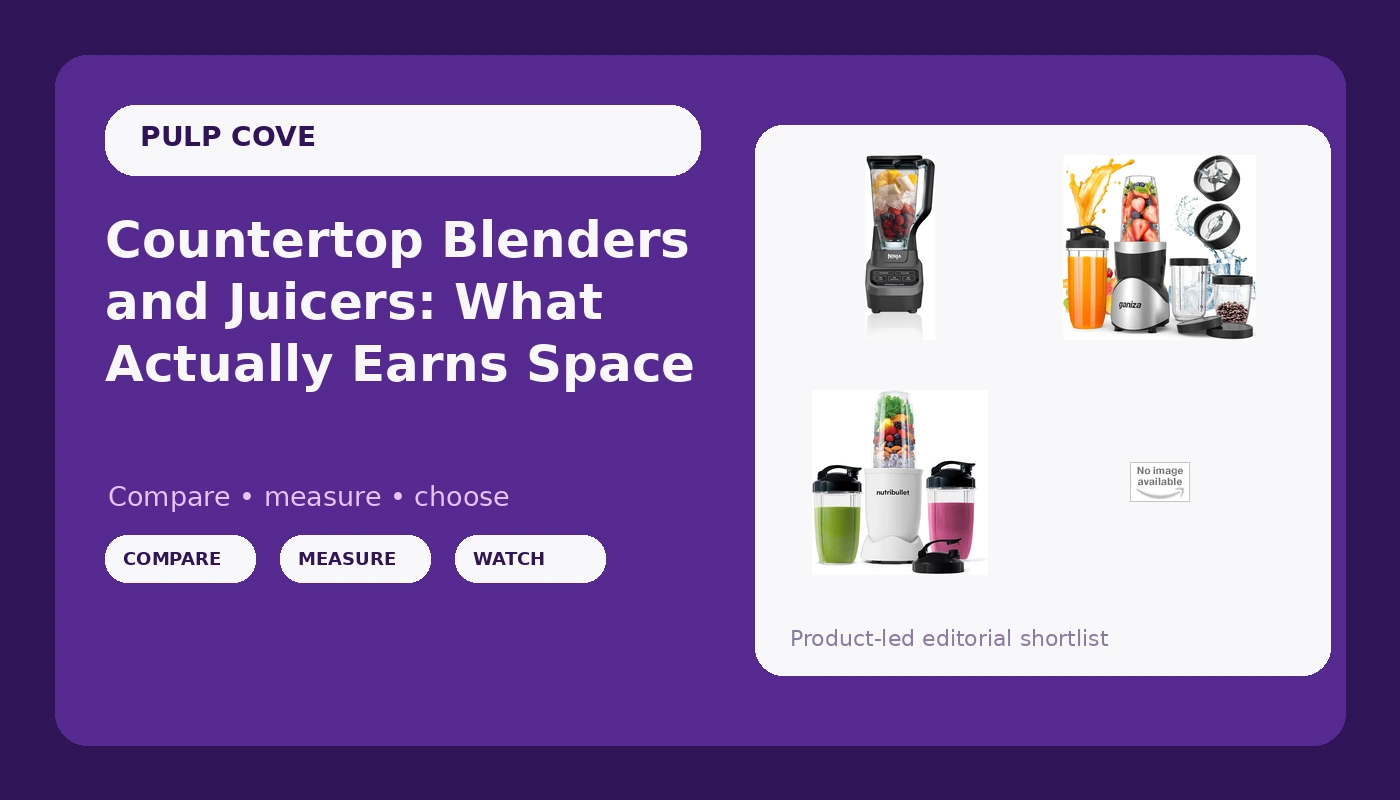
Countertop blenders and juicers all make the same promise: frozen fruit and ice go in, something velvety comes out. The gap between that promise and a Tuesday morning shows up fast. Motor wattage, pitcher volume, cup design, and blade geometry decide whether a machine still delivers on blend fifty, or whether you end up chewing your breakfast. This explainer covers four machines that solve four different problems: a large-capacity blender built for full pitchers, a personal blender built for one cup at a time, a mid-power blender that keeps the entry cost down, and a cold press juicer for people who want juice instead of a smoothie. The point is not to crown a winner. The point is to match a machine to the way you actually eat and drink, and to know which specification matters for that match.
Related: How Blade Dulling Changes Smoothie Texture →
Quick answer
For a full pitcher that serves two or more people, start with the Ninja Professional BL610: a 1000-watt motor, Total Crushing blades, and a 72-ounce pitcher. For one serving you drink straight from the cup, the Nutribullet Pro is the right shape, with a 900-watt motor, a 32-ounce cup, two 24-ounce cups, and flip-top travel lids. If budget drives the decision, the Ganiza 900-watt blender is the lower-cost route to shakes and smoothies. If you want pulp-free juice rather than a blended drink, skip the blenders and choose the cold press juicer. Wattage and capacity are the two numbers worth comparing first, and neither one tells you how a machine will hold up over months of use.
4 useful options
| Model | Best fit | What stands out |
|---|---|---|
| Ninja Professional Blender, 1000W, Total Crushing Tech, 72oz Pitcher, BL610 | Full pitchers for two or more people | 1000-watt motor and a 72-ounce pitcher with Total Crushing Technology |
| Nutribullet Pro Personal Blender, 900 Watt, Matte White | One serving, blended and carried in the same cup | 900-watt motor, a 32-ounce cup, two 24-ounce cups, and flip-top travel lids |
| Ganiza Smoothie Blender, 900W | Shakes and smoothies on a tighter budget | 900-watt motor in a simpler, lower-cost package |
| Cold Press Juicer Machines | Juice rather than smoothies | Low-speed cold press extraction that separates juice from pulp |
Large-batch blender: Ninja Professional BL610
A 72-ounce pitcher is a gift for a family and a curse for a single person. Filling it a third of the way to make one drink means the blades spend their time throwing fruit against the walls instead of pulling it down into the crush zone. The machine works best when the pitcher is loaded to a sensible level, not to the brim. Overloading is how lids pop off mid-blend and how you end up wiping smoothie off the ceiling. If ingredients stall, tamp them down or add liquid rather than piling more on top. The other thing to plan for is blade wear: blades dull with use, and the texture of your drinks is the first place you will notice it. That is the honest trade-off on any large blender, including this one. Also measure your counter before committing, because a full-size pitcher takes up real estate whether you use it or not.
Personal blender: Nutribullet Pro
Cup-based blenders solve the portion problem by making the container the serving size. You blend in the cup you drink from, cap it, and leave. The trade-offs are worth naming. First, the connection points between the base and the cup are moving parts that wear, so a cup that sits snug today can wobble later. Second, personal blenders run at high speed in a small housing, which is why they can sound like a small jet engine in an apartment, so test the noise level before you commit to a 6 a.m. routine. Third, respect the maximum fill line. A cup filled past it will overflow when the blades pull the contents up. This category is about one drink at a time, and it does that job with less cleanup than a full pitcher.
Budget blender: Ganiza Smoothie Blender, 900W
Wattage is the number everyone quotes, and it is only part of the story. Two blenders can both claim 900 watts and behave completely differently depending on jar shape, blade design, and how tightly the ingredients are packed. What a lower-cost machine buys you is a smaller commitment: less money up front, usually a smaller footprint, and fewer parts to clean. What it may cost you is durability and consistency over time, because that is where cheaper components tend to show their limits. Buy this category with realistic expectations. It should crush frozen fruit and ice for a shake without leaving chunks on the first several blends, and it should be easy to rinse. Judge it on texture after a month, not on the spec sheet on day one.
Juicing option: Cold Press Juicer Machines
A juicer is not a blender with a different label, and that distinction matters more than any spec. Blending keeps the fiber in the glass. Juicing removes it. If your reason for drinking a green smoothie is fiber, a juicer works against you. If your reason is a light, pulp-free glass of juice, a blender will frustrate you with a thick drink you have to chew. Cold press machines run slowly, which usually means less noise and less oxidation than a fast spinning centrifugal design, but they take longer and involve more parts to rinse. Before buying any juicer, ask how many days a week you will actually use it. Daily juicers justify the cleanup. Occasional juicers often do not.
Prices and availability may change. Product images, names, and retailer links must be matched by verified ASIN. Do not state a current price, rating, stock status, or measured result without current evidence.
What motor wattage and pitcher size actually change
Wattage describes how much power the motor can draw, not how well the machine blends. A high-wattage motor paired with a poorly shaped jar can still leave frozen fruit spinning in place, and a lower-wattage motor with a good blade and jar design can produce a smooth drink. Treat wattage as a rough indicator of how much work the motor can do without straining, and treat jar design as the thing that decides whether ingredients get pulled into the blades or thrown away from them.
Pitcher size is a workflow decision. A 72-ounce pitcher makes sense when you blend for several people or batch a week of drinks at once. It makes far less sense for one person, because a partly filled large pitcher blends less efficiently and takes up more counter and cabinet space. Personal cups flip that logic: perfect portions, minimal cleanup, no flexibility for a crowd. There is no universally correct size, only the size that matches how many servings leave your kitchen in a typical morning.
Two other specifications deserve attention. First, blade construction, because blades dull and the texture of your drinks degrades as they do. Second, cleanability, including whether every part that touches food can be disassembled and washed without a fight.
Centrifugal juicing versus cold press
Centrifugal juicers spin a shredding disc at high speed and fling juice through a strainer. They are fast, they handle citrus and melon well, and they are generally the cheaper entry point into juicing. Cold press, also called masticating, crushes produce slowly and presses the juice out. The slower pace typically means less heat and less aeration in the finished juice, and it tends to extract more from leafy greens and fibrous vegetables. The cost is time and cleanup. Whichever design you choose, the deciding factor is usually how often you will use it.
- Count how many servings you make per day. Two or more pushes you toward a full pitcher or a larger juicer.
- Decide whether you want smoothies or juice. Fiber in the drink means a blender. Pulp-free liquid means a juicer.
- Measure your counter and the clearance above it before you buy anything.
- Check that the pitcher, cups, lids, and any juicing parts can be disassembled and washed easily.
- Confirm the current motor rating, included parts, and capacity on the live product listing, since listings and bundles change over time.
Practical guidance before you buy
- Match the machine to your smallest realistic use case, not your most ambitious one.
- Budget for blade wear. Every blade dulls, and the question is whether you notice it after a few weeks or after a few years.
- Test noise expectations before you commit to an early morning routine in an apartment.
- Buy only as much capacity as your counter and cabinet can absorb.
- Rinse immediately after blending or juicing. Dried pulp is the hardest part of cleanup.
Which option should you choose?
Choose the Ninja Professional Blender, 1000W, Total Crushing Tech, 72oz Pitcher, BL610 when you blend for more than one person or batch drinks ahead. Choose the Nutribullet Pro Personal Blender when you make a single serving and want to carry it out the door in the same cup. Choose the Ganiza Smoothie Blender, 900W when the budget is the deciding constraint and shakes and smoothies are the main job. Choose the Cold Press Juicer Machines when you want pulp-free juice and will use it often enough to justify the cleanup.
Every claim here is limited to what the manufacturer states about each machine. Durability, noise, and long-term texture are things you verify in your own kitchen over weeks, not things a spec sheet can settle. Confirm current specifications, included accessories, and warranty terms on the product page before you order.
The bottom line
Capacity and job description matter more than wattage. A large pitcher blender serves a household and frustrates a solo drinker. A personal blender serves one person and cannot batch. A budget blender gets you started for less money with a shorter expected lifespan. A cold press juicer makes juice, not smoothies, and only earns counter space if you juice regularly. Pick the machine that matches your actual morning, then judge it on whether the drinks stay smooth after a month of use.